Great artisan dough depends on more than fermentation and flour. A dough sheeter can produce repeatable thickness, reduce hand fatigue, and make laminated pastries, pasta, crackers, and decorative dough work easier to manage.
We’ve gathered 10 manual and electric options ranging from compact countertop machines to larger folding sheeters. Use the comparison and buying advice below to match the machine’s working width, adjustment range, construction, and storage needs to your baking routine.
Best 10 Dough Sheeters for Artisan Baking Picks for 2026
Best Countertop Pick
Brod & Taylor Manual Dough Sheeter

- Compact, electricity-free countertop design
- 0–26 mm adjustable thickness range
- Reversible board and carrying case included
Best For: Home bakers and micro-bakeries making laminated pastries
Best Folding Stainless Steel Pick

- Foldable design for easier storage
- 2–25 mm thickness adjustment
- Stainless steel frame and manual gear system
Best For: Bakers needing a storable tabletop sheeter for varied doughs
Best Wide-Batch Manual Pick
15.5-Inch Folding Dough Sheeter

- Extra-wide board for larger dough portions
- Stainless steel rollers and frame
- Folding, detachable design for storage and cleaning
Best For: Small bakeries and home bakers handling larger batches
Best Commercial Electric Pick
Commercial Electric Dough Sheeter

- Electric, hands-free rolling operation
- 2–30 mm precise thickness adjustment
- Large non-stick PE board and steel body
Best For: Commercial bakeries and cafés needing higher-throughput sheeting
Best Space-Saving Pick
40.9-inch Folding Manual Dough Sheeter

- 0–27 mm range with 50 thickness settings
- Folds for compact kitchen storage
- Food-grade panels and stainless steel body
Best For: Home bakers and compact bakeries needing versatile control
Best Heavy-Duty Option
40.6-inch Foldable Stainless Steel Sheeter

- 0–25 mm adjustment in 0.5 mm increments
- Reinforced alloy frame with stainless steel surfaces
- Folds down for easier storage
Best For: Frequent manual dough preparation across varied recipes
Best for Fine Adjustments
15.5-inch Commercial-Grade Folding Sheeter

- 55 settings from 0 to 27 mm
- Folds for space-efficient storage
- Food-grade stainless steel contact parts
Best For: Compact kitchens needing highly adjustable manual rolling
Best Overall Manual Sheeter
Foldable Commercial Dough Roller

- 0–25 mm range with 0.5 mm adjustments
- Food-grade stainless-steel dough-contact surfaces
- Foldable tabletop design for compact storage
Best For: Artisan bakers needing fine control across varied doughs
Best for Small Food Businesses
Stainless Steel Folding Dough Sheeter

- Approximately 55 settings from 0–25 mm
- Stainless-steel food-contact components
- Folds flat for space-saving storage
Best For: Compact kitchens and small businesses needing versatile manual rolling
Best Compact Pick
Portable 12-Inch Manual Dough Roller
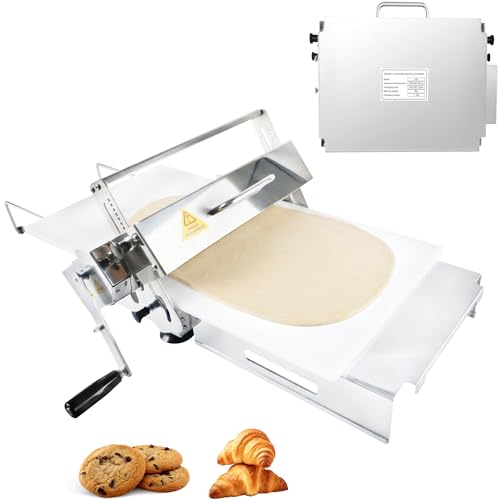
- 0.2–27 mm thickness adjustment
- Integrated food-grade PE non-stick board
- Folds compactly for cabinet or countertop storage
Best For: Portable pastry preparation in home kitchens and small spaces
Best Countertop Pick – Brod & Taylor Manual Dough Sheeter
For home bakers seeking dough sheeters for artisan baking, the Brod & Taylor offers a compact manual setup with unusually fine thickness control. Its 0–26 mm range and reversible board suit laminated pastries as well as pizza, pasta, cookies, and other doughs.
Best For: Home kitchens and micro-bakeries that want portable, electricity-free sheeting for croissants, puff pastry, Danish, and everyday dough projects.
Pros:
- Compact countertop design with no electricity required.
- Adjusts from 0–26 mm, with fine 1 mm increments from 0–6 mm.
- Reversible board provides a non-stick rolling side and rigid cutting side.
- Includes a carrying case for storage and transport.
Cons:
- Manual operation requires hands-on effort.
- Its 16-inch size may be limiting for especially large batches.
This is a versatile choice when workspace and portability matter more than powered throughput. The broad adjustment range and included accessories make it particularly appealing for artisan-style pastry work at home.
Best Folding Stainless Steel Pick – Folding Dough Sheeter
This folding stainless steel model is a practical option among dough sheeters for artisan baking when you need a wide working surface and convenient storage. Its manual roller adjusts from 2–25 mm according to the supplied specifications, making it suitable for both pastry and thicker doughs.
Best For: Bakers who want a foldable tabletop machine for pizza, pastries, bread, cookies, and similar projects.
Pros:
- Stainless steel construction is designed for regular use.
- Foldable structure helps save storage space.
- 360° rotating handle and gear system provide manual rolling control.
- Polished roller surface is intended to reduce sticking and simplify cleanup.
Cons:
- Manual rolling is less hands-free than an electric machine.
- The listed dimensions indicate a substantial footprint when unfolded.
Choose this model if storage flexibility is a priority but you still want a broad, stable tabletop setup. It balances adjustable thickness control with a straightforward manual design for varied baking tasks.
Best Wide-Batch Manual Pick – 15.5-Inch Folding Dough Sheeter
For larger batches of artisan dough, this 15.5-inch folding sheeter provides an extra-wide board intended to roll more dough evenly in one pass. It combines a manual rotating handle, adjustable control knob, stainless steel construction, and a compact folding format.
Best For: Home bakers, cafés, pizzerias, and small bakeries preparing pizza crust, croissants, puff pastry, fondant, tortillas, and laminated dough.
Pros:
- Extra-wide 15.5-inch board supports larger dough portions.
- Stainless steel rollers and frame are described as rust-resistant and food-contact compliant.
- Non-slip feet help improve stability during manual operation.
- Detachable structure and compact design support cleaning and storage.
Cons:
- Manual operation still requires physical effort.
- At 35 pounds, it is not especially lightweight to move.
This model is a strong fit for small-scale production where consistency and working width matter. Its stable base and broad board should appeal to bakers who want to reduce repeated hand rolling without moving to an electric machine.
Best Commercial Electric Pick – Commercial Electric Dough Sheeter
Commercial kitchens looking at dough sheeters for artisan baking may prefer this electric model for hands-free operation and a broad 2–30 mm adjustment range. Its stainless steel body, food-grade PE rolling board, and large 39.3-inch board are geared toward repeated pastry and dough preparation.
Best For: Bakeries, cafés, cake shops, and dessert businesses that need powered sheeting for croissants, pizza, puff pastry, cookies, pasta, fondant, and gum paste.
Pros:
- Electric operation reduces the effort of traditional manual rolling.
- Wide 2–30 mm thickness range accommodates many dough types.
- Food-grade PE non-stick board is designed for easy release and wipe-clean maintenance.
- Heavy-duty stainless steel construction is suited to commercial use.
Cons:
- Its 48-inch overall length requires substantial workspace.
- Powered operation is less portable and flexible than a manual countertop model.
- Its commercial format may be excessive for occasional home baking.
This is the throughput-oriented choice in the group. The large working area and electric drive make it better suited to businesses than casual users, especially where repeated, consistent sheeting justifies the larger footprint.
Best Space-Saving Pick – 40.9-inch Folding Manual Dough Sheeter
For bakers comparing dough sheeters for artisan baking, this manual roller combines fine thickness control with a folding design that suits smaller kitchens. Its 0–27 mm range, 0.5 mm adjustment increments, and smooth hand-crank operation support consistent results across pizza, pastry, bread, and pie dough.
Best For: Home bakers and compact bakeries that need versatile thickness control and convenient storage.
Pros:
- Offers 50 thickness settings from 0 to 27 mm with 0.5 mm precision.
- Folded dimensions help save space between baking sessions.
- Food-grade PP panels and a stainless steel body provide a sturdy, low-stick work surface.
- Includes a 1-year warranty and 24-hour online support.
Cons:
- Manual operation requires turning the handle for each batch.
- Its 40.9-inch unfolded length requires a suitably long workspace.
This is a practical choice when storage is a priority without giving up detailed thickness adjustment. The single-roller, manual format is best suited to users who want controlled small- to medium-batch preparation.
Best Heavy-Duty Option – 40.6-inch Foldable Stainless Steel Sheeter
Among dough sheeters for artisan baking, this foldable manual model stands out for its reinforced alloy frame, food-grade stainless steel contact surfaces, and broad application range. Its dual adjustment system makes it useful for everything from pizza and pie crusts to laminated pastries and pasta sheets.
Best For: Home kitchens, bakeries, restaurants, food trucks, and pizza shops that want a durable manual sheeter.
Pros:
- Provides 0–25 mm adjustment with increments as fine as 0.5 mm.
- Reinforced alloy construction and stainless steel contact surfaces support regular use.
- Foldable design reduces its storage footprint.
- Requires no electricity and uses a smooth 360-degree rotating handle.
Cons:
- At 24.5 pounds, it is relatively heavy to move and store.
- The expanded dimensions require substantial counter or worktable space.
Choose this model if construction and versatility matter more than portability. Its manual design keeps operation simple, while the foldable frame helps make room for it when it is not in use.
Best for Fine Adjustments – 15.5-inch Commercial-Grade Folding Sheeter
For dough sheeters for artisan baking that emphasize detailed control, this 15.5-inch folding machine offers 55 thickness options from 0 to 27 mm. It is designed for manual use across pizza dough, Danish bread, crepes, cookies, and other preparations while remaining easy to fold and store.
Best For: Baking enthusiasts and small catering operations that need many thickness settings in a compact manual machine.
Pros:
- Offers up to 55 adjustable thickness settings across a 0–27 mm range.
- Folding construction supports storage in kitchens with limited space.
- Food-grade stainless steel contact parts are smooth and designed for hygienic use.
- Manual operation avoids dependence on electricity and uses an ergonomic handle.
Cons:
- Only one rolling surface is specified.
- Its 15.5-inch format may provide less working width than larger sheeters.
- The supplied notes do not specify a warranty duration.
This model is a strong fit when incremental thickness control and compact storage are the main priorities. Its alloy body and stainless steel roller support regular use, while the manual format keeps the setup straightforward.
Best Overall Manual Sheeter – Foldable Commercial Dough Roller
For bakers comparing dough sheeters for artisan baking, this foldable manual model stands out for its broad 0–25 mm adjustment range and 0.5 mm increments. Its tabletop format, stainless-steel dough-contact surfaces, and non-electric operation make it practical for home kitchens and small commercial workspaces.
Best For: Bakers who want fine thickness control for laminated doughs, pastry, pasta, pizza, and other dough products while conserving storage space.
Pros:
- Adjusts from 0 to 25 mm in precise 0.5 mm increments.
- Food-grade stainless-steel contact surfaces support routine food preparation.
- Folding work surfaces help reduce its storage footprint.
- Manual handle and gear system provide controlled, electricity-free operation.
Cons:
- Manual operation requires turning the handle instead of using a motor.
- Its extended 40.5-inch-by-22.8-inch working footprint needs adequate counter space during use.
This is a versatile pick when consistent thickness and flexible storage matter more than powered convenience. The reinforced alloy frame and wipe-clean surfaces add practical value for frequent baking sessions.
Best for Small Food Businesses – Stainless Steel Folding Dough Sheeter
This manual option is a practical choice among dough sheeters for artisan baking, offering approximately 55 thickness settings across a 0–25 mm range. Its stainless-steel construction, folding mechanism, and electricity-free operation suit kitchens or small food businesses where straightforward maintenance and space efficiency are priorities.
Best For: Home bakers and small food businesses making croissants, Danish pastries, pasta, dumpling wrappers, pizza, cookies, and similar products.
Pros:
- Approximately 55 settings provide fine thickness adjustment up to 25 mm.
- Food-contact components use stainless steel.
- Folds flat to help optimize limited kitchen space.
- Ergonomic handle is designed for smooth manual rotation.
Cons:
- Manual operation does not provide powered rolling.
- The listed number of settings is presented as one in the product details, despite the approximately 55 adjustment positions described in the features.
Choose this model if easy wipe-down maintenance and compact storage are central to your setup. It offers broad application range without requiring an electrical connection.
Best Compact Pick – Portable 12-Inch Manual Dough Roller
For compact dough sheeters for artisan baking, this 12-inch model combines a wide 0.2–27 mm adjustment range with a foldable body and integrated non-stick rolling board. Its portable format is aimed at home kitchens, cafés, and small bakeries that need flexible pastry preparation without a large permanent setup.
Best For: Home and small-business bakers who value portability, easy dough release, and storage in a cabinet or on a countertop.
Pros:
- Offers precise adjustment from 0.2 to 27 mm.
- Food-grade PE rolling board provides a non-stick dough-contact surface.
- Folds to approximately 10.4 by 13.7 by 4.4 inches for storage.
- Manual design is described as lightweight and user-friendly.
Cons:
- Its 12-inch rolling format is more compact than the larger tabletop models.
- Manual operation still requires physical effort during rolling.
This is the most portability-focused option in the group. The integrated non-stick board and broad adjustment range make it especially useful for varied home pastry projects when workspace is limited.
How We Picked the Best Dough Sheeters for Artisan Baking
We focused on the features that matter most when rolling dough repeatedly and consistently: thickness range, adjustment precision, roller or board width, construction materials, operating style, cleanup, storage, and overall suitability for home or commercial use. The selection includes compact manual models, wider foldable machines, and an electric option for higher-volume work.
Because product specifications can vary, confirm the listed dimensions, usable roller width, adjustment increments, included accessories, and electrical requirements before ordering. A machine’s maximum width is not always the same as its practical working area.
Quick Comparison
| Best For | Look For | Most Suitable Type |
|---|---|---|
| Occasional home baking | Compact footprint and simple controls | Portable manual sheeter |
| Laminated pastries | Fine thickness adjustment and smooth rollers | Precision manual or electric model |
| Large pastry sheets | Wide rollers and a stable frame | Full-size folding sheeter |
| Frequent production | Consistent output and reduced hand effort | Commercial electric sheeter |
| Limited storage | Folding legs or a removable setup | Foldable countertop model |
Key Buying Factors for Dough Sheeters for Artisan Baking
Thickness Control
Check both the minimum and maximum settings, but also consider how precisely you can move between them. A broad adjustment range is useful for everything from thin crackers to thicker pastry, while clearly marked settings make repeat batches easier.
Working Width and Stability
Wider rollers handle larger dough portions but require more counter space. Stability matters just as much: a rigid stainless-steel frame, secure feet, and a firm mounting surface help prevent shifting during use.
Manual Versus Electric Operation
Manual sheeters are generally simpler, quieter, and easier to store. They suit home bakers and intermittent production. Electric models are better when you need repeated, uniform sheets or want to reduce wrist and shoulder strain, but they typically require more space, cleaning, and budget.
Materials and Cleanup
Food-grade stainless steel is durable and straightforward to wipe down. Non-stick boards can help with dough release, although flour, butter, and laminated dough still require prompt cleaning. Look for accessible rollers and avoid immersing electrical components unless the manufacturer explicitly permits it.
Who Should Buy Which Dough Sheeters for Artisan Baking?
Choose a compact manual model if you bake occasionally, have limited counter space, or want a machine that can be stored between uses. A wider folding sheeter is the better fit for croissant dough, puff pastry, and other projects where sheet size and repeatability matter. If you regularly prepare multiple batches, sell baked goods, or want less physical effort, prioritize the electric commercial model and verify that its power and capacity suit your workspace.
For most artisan home bakers, the best choice is not necessarily the widest or most powerful machine. Select the smallest model that offers your required thickness range and dough width, then prioritize stable operation, easy cleanup, and convenient storage.