Choosing the right commercial dough mixer can make bread, pizza, and pastry production more consistent while reducing manual labor. The best model depends on batch size, dough type, available power, and how often your kitchen operates.
This roundup compares 10 commercial dough kneading machines across compact countertop options and high-capacity floor-style mixers, highlighting practical differences to help you select a dependable fit for your workflow.
Best 10 Dough Kneading Machine Commercial Picks for 2026
High-Volume Pick
50QT Dual-Action Commercial Dough Mixer

- 50-quart stainless steel bowl
- 2,200W motor with two speeds
- Dual-action mixing and safety cover
Best For: High-volume bakeries and pizzerias
Compact Spiral Pick
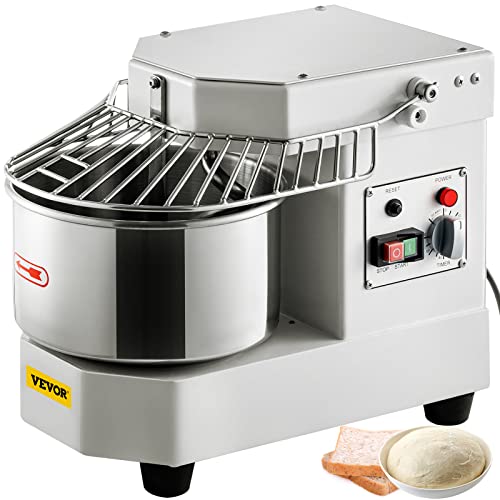
- Handles up to 6.6 pounds of dough
- Dual rotation for even kneading
- 60-minute timer and safety shield
Best For: Moderate-volume kitchens with limited space
Heavy-Duty Tilt Pick

- 25kg dough capacity
- 2,200W all-copper motor
- 90-degree tilting bowl
Best For: Large-batch bakeries, restaurants, and schools
Versatile Mixer Pick

- Three included mixing attachments
- Three speeds and a 30-minute timer
- Food-contact parts use stainless steel
Best For: Commercial kitchens making varied recipes
Best All-Around Control
10.6 Qt Commercial Spiral Dough Mixer

- Nine speeds with 130–360 RPM hook control
- Removable 304 stainless steel bowl
- Handles 1.1–11 lb of flour per batch
Best For: Pizza shops, bakeries, and commercial kitchens needing adjustable mixing control
Best Heavy-Duty Capacity
TECHTONGDA 15 KG Commercial Dough Mixer

- 33.1 lb stated dough capacity
- 1,500W all-copper motor
- 90-degree tilting stainless steel bowl
Best For: High-volume kitchens needing large batches and straightforward operation
Best Timed Compact Option

- Programmable timer up to 30 minutes
- Five speeds with a 750W motor
- Tool-free removable bowl and spiral drill
Best For: Smaller operations wanting timed mixing and convenient cleanup
Best Compact Commercial Pick
Garvee 10.5-Quart Dual-Rotation Mixer

- Handles up to 11 pounds of dough
- Dual rotation with stainless steel food-contact parts
- Timer and safety shield included
Best For: Small commercial kitchens and moderate-size dough batches
Best Mid-Size High-Power Pick
INTBUYING 18-Quart Dough Mixer
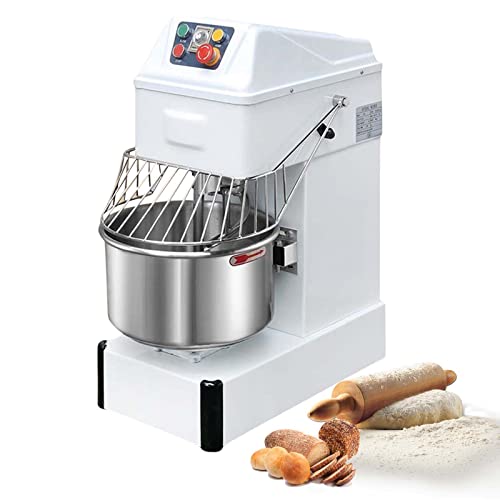
- 20-liter barrel handles up to 8 kilograms
- 1500W copper-wire motor
- Timed two-speed mixing program
Best For: Bakeries and pizzerias needing larger repeatable batches
Best High-Volume Production Pick

- Handles up to 72.75 pounds of dry flour
- Dual-action mixing with two speeds
- Emergency stop and cover-activated cutoff
Best For: High-volume commercial bakeries with three-phase power
High-Volume Pick – 50QT Dual-Action Commercial Dough Mixer
For bakeries, pizzerias, and other busy kitchens, this dough kneading machine commercial model is built for large batches. Its 50-quart stainless steel bowl, 2,200-watt motor, dual-action mixing, and two speeds support consistent dough production.
Best For: High-volume bakeries, pizzerias, restaurants, and institutional kitchens.
Pros:
- Large 50-quart, food-grade 304 stainless steel bowl
- Dual-action bowl and hook rotation promotes even mixing
- Two gearbox-driven speeds suit soft and firm dough
- Safety cover automatically cuts power when opened
Cons:
- Large 30.3-by-30.3-by-35.4-inch footprint requires substantial space
- Designed for commercial-scale batches rather than small countertop use
This is the strongest choice here when throughput and batch capacity matter most. Its size and heavy-duty design make it less practical for compact kitchens, but well suited to daily professional production.
Compact Spiral Pick – VEVOR 8.5Qt Timed Dough Mixer
This compact dough kneading machine commercial option combines an 8-liter stainless steel bowl with dual rotation and a 60-minute timer. It can handle up to 6.6 pounds of dough while remaining considerably smaller than large-batch floor mixers.
Best For: Smaller bakeries, restaurants, hotels, and kitchens needing timed dough mixing.
Pros:
- Mixes up to 6.6 pounds of dough per batch
- Dual rotation helps simulate manual kneading
- 60-minute timer supports more hands-off operation
- Safety shield, automatic shutoff, and nonslip feet improve usability
Cons:
- Only one listed speed limits adjustment options
- 450W motor and 8-liter bowl are intended for smaller batches
- Listed noise level is 70 dB
Choose this model if you want commercial-oriented construction and timed mixing without moving up to a very large machine. Its capacity is more appropriate for moderate production than continuous high-volume dough work.
Heavy-Duty Tilt Pick – TECHTONGDA 25KG Dough Mixer
For demanding production, this dough kneading machine commercial model offers a 25-kilogram kneading capacity, a 2,200-watt all-copper motor, and a full stainless steel build. Its two-way mixing control and 90-degree tilt help with both dough processing and removal.
Best For: Schools, bakeries, restaurants, and pizzerias handling large dough batches.
Pros:
- Handles up to 25 kilograms, or 55.1 pounds, of dough
- Full food-grade stainless steel construction is durable and easy to clean
- 90-degree tilting bucket simplifies dough removal and cleaning
- Automatic stopping activates when the window is opened
Cons:
- Very large 41-by-31-by-41-inch dimensions require dedicated floor space
- One listed speed offers less mixing flexibility
- Designed for large batches rather than small-scale preparation
The tilting bowl is this machine’s standout convenience, especially when working with heavy dough. It is a practical production-focused choice, provided your kitchen can accommodate its substantial footprint.
Versatile Mixer Pick – VEVOR 15Qt Three-Speed Mixer
This dough kneading machine commercial model is suited to kitchens that need more than dough mixing. It includes a dough hook, flat beater, and wire whip, plus three speeds and a 30-minute timer for switching between doughs, fillings, batters, and whipped mixtures.
Best For: Restaurants, bakeries, pizzerias, and commercial kitchens making varied recipes.
Pros:
- Includes dough hook, flat beater, and wire whip
- Three speeds support kneading, mixing, and whipping
- 30-minute timer reduces the need for constant monitoring
- Stainless steel bowl and food-contact components are easy to clean
Cons:
- Food capacity is limited to about 3.3 pounds per batch
- 500W motor is less suited to very large dough production
- Speed must be changed only after stopping the machine
This is the most flexible option for kitchens preparing multiple food types, rather than dough alone. Its attachments and speed range add versatility, while the relatively modest dough capacity makes it better for smaller batches.
Best All-Around Control – 10.6 Qt Commercial Spiral Dough Mixer
For a dough kneading machine commercial setup that needs more control than a single-speed mixer, this 10.6-quart spiral model offers nine speed settings, a removable stainless steel bowl, and a dough-temperature display. It handles 1.1–11 pounds of flour per batch, although that figure refers to flour rather than finished dough weight.
Best For: Pizza shops, bakeries, and commercial kitchens needing adjustable mixing speeds and batch flexibility.
Pros:
- Spiral hook and rotating bowl are designed for pizza and bread dough.
- Nine speeds with a 130–360 RPM hook range support more precise dough control.
- Removable 304 stainless steel bowl and tilt-head access simplify loading and cleanup.
- Safety guard stops mixing when raised, and the display monitors dough temperature.
Cons:
- At approximately 93 pounds, it is not especially portable.
- The unit is relatively large and requires 120V power.
- No separate beaters are included.
Its combination of capacity, speed adjustment, reverse function, and temperature monitoring makes it a versatile choice for operators who want fine control over recurring dough batches.
Best Heavy-Duty Capacity – TECHTONGDA 15 KG Commercial Dough Mixer
This dough kneading machine commercial model is built for larger batches, with a stated 33.1-pound dough capacity and a 1,500-watt all-copper motor. Its full stainless steel construction, two-way mixer rotation, and 90-degree tilting bowl are aimed at demanding kitchen environments.
Best For: Commercial kitchens, bakeries, restaurants, and other operations that prioritize large-batch capacity and sturdy construction.
Pros:
- Mixes up to 33.1 pounds of dough in a working cycle.
- Full food-grade stainless steel construction is sturdy and easy to clean.
- Two-way rotation supports mixing and helps with dough removal.
- 90-degree tilting bowl makes unloading and cleaning more convenient.
Cons:
- It has only one speed, offering less adjustment than multi-speed mixers.
- The listed dimensions are substantial, so it requires significant floor space.
- Its 110V, 1,500-watt design may require checking the available electrical setup.
This is the capacity-focused option in the group. The large tilting bowl and powerful motor suit high-volume work, while the single-speed control keeps operation straightforward rather than highly customizable.
Best Timed Compact Option – INTBUYING 10 Qt Dough Mixer
For a dough kneading machine commercial buyers may also use in a smaller workspace, this INTBUYING model combines a 10-quart-class bowl with a programmable timer of up to 30 minutes. The 750-watt motor, visible cover, detachable spiral tool, and removable bowl are geared toward convenient everyday preparation.
Best For: Small bakeries, pizza shops, restaurants, and home users who want timed mixing and easier cleanup.
Pros:
- Timer can be set for up to 30 minutes, reducing the need for constant monitoring.
- Five speeds provide more flexibility than a single-speed mixer.
- Visible cover lets users observe the mixing process.
- Detachable spiral drill and bowl can be removed without tools for cleaning.
Cons:
- The stated capacity is 11 pounds, making it better suited to smaller batches than the 15 kg model.
- It uses 110V power, so electrical compatibility should be confirmed.
- The supplied notes do not specify a dough-temperature display or a tilt-bowl design.
Its timer and compact listed footprint make this a practical convenience-oriented choice. It is particularly appealing when repeatable mixing cycles and quick disassembly matter more than maximum batch capacity.
Best Compact Commercial Pick – Garvee 10.5-Quart Dual-Rotation Mixer
If you need a dough kneading machine commercial kitchens can use without moving up to an oversized unit, the Garvee 10.5-quart mixer offers a practical middle ground. Its 650W motor, dual-rotation action, stainless steel bowl, and 60-minute timer support dough batches of up to 11 pounds.
Best For: Small restaurants, bakeries, pizzerias, and serious home bakers handling moderate dough batches.
Pros:
- 10.5-quart bowl can handle up to 11 pounds of dough.
- Dual-rotation design helps increase contact between the dough and spiral hook.
- Timer, safety shield, overload protection, and nonslip feet support easier operation.
- Food-contact components are made from food-grade stainless steel.
Cons:
- Its capacity is smaller than the larger commercial mixers in this roundup.
- At 105 pounds, it still requires a dedicated, stable workspace.
- Only two speeds are available.
The Garvee is a sensible choice when you want commercial-oriented features and dual action in a more manageable format. Its 110V power requirement also makes it more accessible than heavy-duty three-phase equipment.
Best Mid-Size High-Power Pick – INTBUYING 18-Quart Dough Mixer
The INTBUYING 18-quart model is a strong option if your dough kneading machine commercial setup needs more capacity and power than a compact mixer provides. Its 1500W motor, dual-action mixing, 20-liter barrel, and timed two-speed program are designed for batches up to 8 kilograms of dough.
Best For: Bakeries, pizza operations, and food businesses that need larger batches with automated timing.
Pros:
- 20-liter barrel handles up to 8 kilograms of dough at once.
- 1500W copper-wire motor supplies strong driving torque.
- Dual-action mixing keeps the dough in contact with the mixer across the barrel.
- Timed low-speed, high-speed, and stop functions simplify repeatable mixing.
Cons:
- At 270 pounds, it is difficult to reposition once installed.
- Its 34.4-inch height and 24.4-inch depth require substantial floor space.
- The two-speed design offers less adjustment than a variable-speed mixer.
With its larger working capacity and higher wattage, the INTBUYING is better suited to regular production than occasional baking. The safety cover and approximately 65 dB operating level add practical benefits for a commercial environment.
Best High-Volume Production Pick – 80-Quart 220V Dough Mixer
For high-output bakeries and pizzerias, this 80-quart dough kneading machine commercial model is built around production-scale capacity. Its stainless steel construction, dual-action bowl and head, two speeds, emergency stop, and 220V three-phase power are intended for demanding commercial workloads.
Best For: High-volume bakeries, pizza shops, and restaurants with dedicated three-phase electrical service.
Pros:
- 80-quart capacity handles up to 72.75 pounds of dry flour.
- Dual-action mixing rotates both the bowl and spiral head for more uniform mixing.
- Pure copper motor supports two speeds of 120 and 210 RPM.
- Protective-cover cutoff and emergency-stop switch provide important safety controls.
Cons:
- Requires separate 220V three-phase wiring.
- Its approximately 428-pound net weight and large footprint make installation demanding.
- The notes specifically indicate that it is not suitable for home use.
This is the production-focused choice for businesses that can support its electrical and space requirements. The large stainless steel frame and 80-quart bowl prioritize sustained commercial output over portability or household convenience.
How We Picked the Best Dough Kneading Machine Commercial
We evaluated these machines around the factors that matter most in a working bakery, pizzeria, restaurant, or food-production kitchen. The comparison considers bowl capacity, motor output, kneading design, speed settings, timing controls, construction, safety features, and electrical requirements.
Capacity figures are useful starting points, but they do not always represent the same usable dough load. Flour type, hydration, recipe density, and the manufacturer’s recommended limit can affect real-world performance. We also separated smaller 8.5- to 15-quart machines from larger commercial mixers so buyers can compare equipment against their expected batch volume.
Quick Comparison
| What to Compare | Best For | Typical Advantage |
|---|---|---|
| 8.5–10.6 quarts | Small bakeries, cafés, and home-based businesses | Smaller footprint and easier batch control |
| 15–18 quarts | Growing kitchens and regular pizza production | More capacity without the footprint of the largest mixers |
| 25 kg or 50–80 quarts | High-volume bakeries and commercial food service | Fewer batches and greater production throughput |
| Spiral or dual-action mixing | Bread and pizza dough workflows | Purpose-built kneading for heavier doughs |
Key Buying Factors for a Dough Kneading Machine Commercial Setup
Capacity and Batch Size
Choose a mixer based on your actual dough batch, not just the bowl’s advertised volume. Leave enough room for ingredients to circulate safely, and check whether the stated capacity refers to flour weight, finished dough, or total bowl volume.
Motor, Kneading Action, and Speed
Higher wattage can indicate more available power, but motor design and transmission also matter. Spiral mixers and dual-action machines are generally better suited to repeated bread or pizza dough batches. Multiple speeds can help with mixing and finishing, while a single-purpose machine may be simpler to operate.
Controls and Safety
A timer helps staff repeat recipes and avoid unnecessary overmixing. Look for emergency stops, bowl guards or security shields, overload protection, and controls that are easy to use while wearing food-service gloves.
Construction and Maintenance
Stainless steel bowls and housings are practical in commercial kitchens because they resist corrosion and are easier to sanitize. Confirm that removable parts, attachments, and guards can be cleaned without excessive disassembly.
Electrical Requirements and Space
Verify voltage, amperage, plug type, and circuit needs before ordering. A large 220V mixer may require professional installation, while a 110V unit can be easier to deploy. Measure doorways, counters, storage areas, and clearance around the bowl.
Who Should Buy Which Dough Kneading Machine Commercial?
Choose a compact 8.5- to 10.6-quart machine if you produce modest batches and need a countertop-friendly solution. A 15- to 18-quart mixer is a better middle ground for cafés, small bakeries, and pizzerias with steady daily demand. For large production runs, prioritize a 25 kg, 50-quart, or 80-quart commercial unit, provided your electrical setup and floor space can support it.
If pizza and bread are your main products, favor a spiral or dual-action kneading design. If your menu includes broader mixing tasks, a food mixer with multiple speeds may offer greater flexibility. Before buying, match the manufacturer’s rated capacity and duty cycle to your busiest expected production day rather than your average workload.