Small-batch bread baking is easier when dough can ferment in a stable, draft-free environment. The right proofing box helps maintain dependable warmth and gives you more control over timing without taking over your kitchen.
We compare 10 bread proofing boxes for small batches, ranging from simple lidded containers to folding models with adjustable temperature settings and timers. Use the guide below to match capacity, controls, storage needs, and dough volume to your baking routine.
Best 10 Bread Proofing Boxes for Small Batches Picks for 2026
Best All-in-One Containers
Brod & Taylor 6L Proofing Containers

- Two stackable 6L containers
- Volume markings monitor dough rise
- Dishwasher- and freezer-safe design
Best For: Home bakers wanting reusable containers for bread, sourdough, and pizza dough
Best Compact Heated Option
Folding Proofing Box With Heater

- 50–130°F digital temperature range
- 24-hour timer with audible alarm
- Folds flat for compact storage
Best For: Apartment bakers proofing one bowl, banneton, or starter setup
Best for Multiple Dough Balls

- Two roomy 16L proofing boxes
- Fits about four to six dough balls
- Transparent, clip-on-lid design
Best For: Home pizza makers refrigerating multiple dough portions
Best for Long Ferments
ParmedU Folding Temperature-Controlled Box

- 41–122°F temperature control
- Movable probe and four heating zones
- 99-hour timer with foldable design
Best For: Sourdough bakers managing overnight or extended ferments
Best Stackable Batch Box

- Holds up to six dough balls
- BPA-free polypropylene construction
- Stackable with labels and markers included
Best For: Organizing multiple pizza or bread dough portions
Best Temperature-Controlled Option

- Adjustable 50–113°F temperature range
- 48-hour timer and three heating zones
- Folds for convenient storage
Best For: Temperature-controlled proofing of one standard bowl
Best Overall

- Three-sided heating with 75–113°F control
- 36L capacity for multiple loaves
- Folds flat and includes a viewing window
Best For: Home bakers needing precise control and generous capacity
Most Portable
Foldable Proofing Box with Carry Bag

- 50–105°F control with a 48-hour timer
- 20L insulated, collapsible interior
- Carry bag and viewing window included
Best For: Portable small-batch baking and multi-use fermentation
Best Temperature Sensing
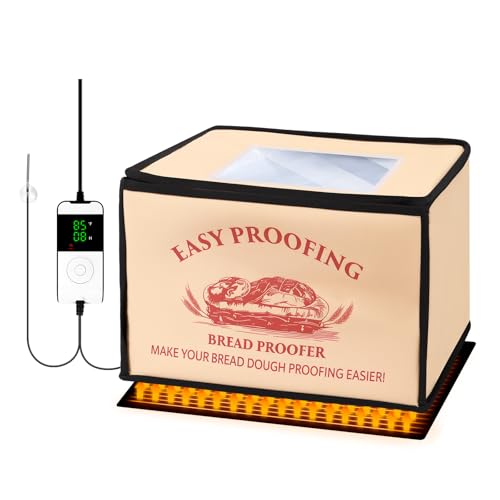
- NTC sensor monitors dough temperature
- 50–113°F control with a 12-hour timer
- Foldable 16-by-12-by-10-inch insulated design
Best For: Small batches requiring closer temperature monitoring
Best All-in-One Containers – Brod & Taylor 6L Proofing Containers
For bread proofing boxes for small batches, the Brod & Taylor two-pack is a practical choice when you want to mix, fold, and proof in the same container. Translucent walls, volume markings, and lidded humidity control make it easier to monitor dough without disturbing the rise.
Best For: Home bakers who want durable, stackable containers for bread, sourdough, and pizza dough.
Pros:
- 6-liter capacity can hold up to 3,000 grams of dough.
- Volume markings help track dough expansion without opening the lid.
- Dishwasher-safe, freezer-friendly polypropylene is designed to resist stains and odors.
- Two low-profile containers stack in refrigerators or compatible proofers.
Cons:
- These containers do not actively heat the dough.
- The relatively large capacity may be more than needed for very small dough portions.
This set is especially useful if you prefer a straightforward, low-maintenance proofing setup rather than a temperature-controlled appliance. Its main advantage is combining generous capacity with easy rise tracking and cleanup.
Best Compact Heated Option – Folding Proofing Box With Heater
This heated box is a useful option among bread proofing boxes for small batches when room temperature is inconsistent. Its digital controls, 50–130°F range, timer, and fold-flat design support controlled proofing while keeping the footprint manageable.
Best For: Apartment bakers who need temperature control for one bowl, a banneton, or several starter jars.
Pros:
- Adjustable 50–130°F range with a Celsius/Fahrenheit toggle.
- Built-in 24-hour timer and audible alarm help limit over-proofing.
- Compact chamber fits a bowl up to 5 liters and folds flat for storage.
- NTC temperature sensing and automatic overheat protection support steady operation.
Cons:
- The chamber is intended for relatively small setups rather than large batches.
- It requires an electrical outlet and has a 100-watt power rating.
Choose this model if consistent warmth matters more than using a simple passive container. The timer and portability are convenient, while the compact interior suits everyday home baking and fermentation projects.
Best for Multiple Dough Balls – Vababa 16L Pizza Dough Boxes
For bakers comparing bread proofing boxes for small batches, this two-pack offers a roomy, transparent solution for several pizza or bread dough portions. The 16-liter boxes are sized for refrigerator shelves and can accommodate approximately four to six dough balls each.
Best For: Home pizza makers who proof multiple dough balls together in the refrigerator.
Pros:
- Large 16-liter capacity can hold four to six dough balls.
- Transparent plastic makes the contents easy to see at a glance.
- Clip-on lids are designed to fasten tightly and help prevent water loss.
- Two boxes provide flexibility for separate dough batches or other food storage.
Cons:
- The boxes are larger than necessary for a single small loaf.
- They do not include active heating or temperature controls.
- The supplied details identify the material as plastic but do not specify dishwasher safety.
This set makes the most sense when your small batch includes several pizza portions rather than one loaf. Its generous footprint and clip-on lids favor refrigerator fermentation and organized batch storage.
Best for Long Ferments – ParmedU Folding Temperature-Controlled Box
This folding heated box stands out among bread proofing boxes for small batches when you want precise control over extended fermentation. It combines a 41–122°F range, a movable temperature probe, four heating zones, and a 99-hour timer in a storage-friendly design.
Best For: Sourdough bakers managing overnight or long ferments in a bowl, basket, or small tray.
Pros:
- Adjustable 41–122°F range supports dough, starter, and other fermentation projects.
- Movable probe can monitor either dough-core or box-air temperature.
- Four heating zones distribute warmth around the chamber.
- 99-hour timer and foldable construction suit long ferments and compact kitchens.
Cons:
- The 5-liter capacity limits it to relatively small batches.
- It requires setup and electrical power rather than working as a passive container.
- The exterior must be wiped clean with a damp cloth rather than described as dishwasher safe.
Among these options, this is the strongest fit for bakers who want detailed temperature monitoring and a timer longer than one day. Its probe and multi-zone heating add control, while the foldable body helps offset the appliance’s counter-space demands.
Best Stackable Batch Box – Commercial Dough Proofing Box
For bakers comparing bread proofing boxes for small batches, this polypropylene container is a practical choice for organizing several dough portions at once. Its rectangular 15.67-by-11.69-inch footprint holds up to six dough balls, while the stackable design helps conserve refrigerator or prep-station space.
Best For: Pizza makers, home bakers, and small food-service kitchens proofing multiple dough balls together.
Pros:
- Holds up to six dough balls in a 3.2-gallon container.
- BPA-free, food-grade polypropylene is stain resistant and dishwasher safe.
- Stacks with or without the lid to simplify storage.
- Includes a FIFO label sticker and two erasable markers for batch tracking.
Cons:
- The 4-inch height may be less suitable for a single large dough mass or very high expansion.
- The intentionally non-airtight lid allows airflow, so it is not designed for fully sealed storage.
This is a strong fit when capacity, repeatable organization, and easy stacking matter more than temperature control. The non-airtight lid is tailored to fermentation, while the included labeling tools are useful for managing multiple batches.
Best Temperature-Controlled Option – Folding Heated Bread Proofer
Among bread proofing boxes for small batches, this folding heated proofer stands out for bakers who want to actively manage fermentation temperature. It offers adjustable warming from 50 to 113°F, a timer of up to 48 hours, and a metal rack sized to fit one standard proofing bowl.
Best For: Home bakers proofing sourdough, bread, or pizza dough in a cool kitchen and wanting adjustable warmth.
Pros:
- Three heating zones provide front, back, and bottom warming.
- Temperature adjusts from 50 to 113°F with a timer up to 48 hours.
- Folds for more compact storage when not in use.
- Viewing window lets you monitor dough without opening the box.
Cons:
- Its capacity is aimed at one standard proofing bowl rather than several individual dough balls.
- Requires access to power and adds an electronic component to the proofing setup.
- The 11-by-15-by-11-inch form factor may require more storage space than a flat tray.
This is the most versatile choice for temperature-sensitive fermentation, especially sourdough starters and dough in cooler conditions. Its foldable construction helps offset the larger working footprint, but it is less focused on multi-ball storage than a traditional stackable box.
Best Large-Capacity Tray – 5-Quart Dough Proofing Container
For bread proofing boxes for small batches that prioritize visibility and flexible dough handling, this 5-quart translucent container offers a spacious tray format. It holds up to 6.6 pounds of dough or six dough balls, with markings that make it easier to follow the rise without lifting the lid.
Best For: Bakers who want to mix, stretch, fold, and proof dough in one stackable container.
Pros:
- 5-quart capacity accommodates up to 6.6 pounds of dough or six dough balls.
- Translucent walls and volume markings make rising easier to monitor.
- Lid helps retain moisture and protect dough from drying out.
- BPA-free polypropylene is designed to resist stains, odors, and sticky residue.
Cons:
- The single-pack format may require additional containers for larger production runs.
- Its lid is intended to retain humidity, so it offers a different airflow approach than a non-airtight proofing lid.
- The 4-inch height may limit very tall dough expansion.
This container is a practical middle ground for small batches: roomy enough for several dough balls, low enough for refrigerator storage, and clear enough to track fermentation. Its wide base also supports stretch-and-fold work directly in the tray.
Best Overall – Folding 36L Bread Proofer
For bakers comparing bread proofing boxes for small batches, this folding model combines a spacious 36-liter interior with three-sided heating, adjustable temperature control, and a clear front window. Its collapsible design also makes storage easier when the proofer is not in use.
Best For: Home bakers who want precise control and room for multiple loaves or dough containers.
Pros:
- Three-sided heating helps create a stable warming environment.
- Temperature adjusts from 75–113°F, with a 24-hour timer.
- 36-liter capacity and included rack accommodate multiple loaves.
- Folds down for more compact storage and includes a viewing window.
Cons:
- The larger capacity may be more than needed for very small batches.
- Heating elements and power supply require wiping rather than washing.
This is the most feature-rich option of the three, especially if you want extended timing, broad temperature control, and a rigid, heated setup. Choose it when capacity and consistency matter more than the smallest possible footprint.
Most Portable – Foldable Proofing Box with Carry Bag
This insulated proofing box is a practical choice for bread proofing boxes for small batches when portability and flexible fermentation are priorities. Its 20-liter interior, foldable construction, carry bag, and zipper closure suit home bakers who need a compact setup that can be stored or transported easily.
Best For: Bakers who want a portable, insulated proofer for dough, yogurt, kombucha, and similar projects.
Pros:
- Adjustable 50–105°F temperature range and timer up to 48 hours.
- Oxford fabric, insulated cotton, and aluminum foil lining support heat retention.
- Foldable design and included carry bag simplify storage and transport.
- Viewing window lets you monitor fermentation without opening the box.
Cons:
- Its 20-liter capacity is smaller than the 36-liter alternative.
- The temperature range tops out at 105°F.
With the longest timer range in this group and a portable soft-sided design, this model is well suited to varied fermentation schedules. It is a strong fit for small batches and kitchens where easy storage is as important as temperature control.
Best Temperature Sensing – Folding Dough Warming Box
For bread proofing boxes for small batches, this 16-by-12-by-10-inch warming box offers a useful balance of capacity and compact storage. Its NTC temperature sensor monitors the dough environment, while the 50–113°F control, 12-hour timer, and insulated three-layer construction support repeatable fermentation.
Best For: Home bakers who want real-time temperature sensing and space for several dough bowls.
Pros:
- NTC sensor is designed to monitor the actual dough temperature.
- 50–113°F temperature range with an LED 12-hour timer.
- 16-by-12-by-10-inch interior accommodates multiple fermentation bowls.
- Foldable insulated construction includes a transparent viewing window.
Cons:
- The timer is limited to 12 hours.
- It is hand-wash only and is not oven or microwave safe.
This model stands out for bakers who value temperature feedback rather than relying only on ambient settings. Its insulated fabric construction and foldable format make it a practical middle-ground option for regular small-batch proofing.
How We Picked the Best Bread Proofing Boxes for Small Batches
We focused on features that matter during everyday bread, sourdough, and pizza-dough fermentation: usable capacity, temperature range, timer length, ease of cleaning, portability, and storage. We also separated straightforward proofing containers from heated or temperature-controlled boxes, since each suits a different type of baker.
Capacity claims can vary by dough type and how much expansion room you need, so treat listed volume as a guide rather than a target fill line. A container that is slightly larger than your batch is usually more practical than one filled to the lid.
Quick Comparison
| Best For | Look For | Typical Advantage |
|---|---|---|
| Occasional small batches | Lidded proofing container | Simple setup and easy cleanup |
| Cool kitchens | Adjustable heat control | More consistent fermentation |
| Overnight or long fermentation | Extended timer | Less hands-on monitoring |
| Limited storage | Folding design | Compact storage between bakes |
| Several pizza dough balls | Wide, stackable tray | Efficient batch organization |
Key Buying Factors for Bread Proofing Boxes for Small Batches
Capacity and Shape
Choose a box based on the number and size of dough portions you normally make. A compact container works well for one loaf or a modest sourdough batch, while a wide tray is better for multiple pizza balls. Leave room for the dough to rise without touching the lid.
Temperature Control
Heated models are useful when your kitchen is cold or ambient temperatures change throughout the year. Look for an adjustable range rather than a single heat setting, and avoid excessive warmth that can speed fermentation too aggressively or damage delicate dough development.
Timer and Monitoring
A timer can provide a useful reminder, but it does not replace checking dough readiness. Longer timer ranges suit overnight schedules, while shorter timers are adequate for same-day baking. Clear lids, labels, or easy access also make it simpler to track progress.
Cleaning and Storage
Removable trays and smooth food-contact surfaces simplify cleanup after sticky dough. Folding proofers are attractive for small kitchens, but confirm that the frame, heating surface, and controls can be stored safely when collapsed.
Who Should Buy Which Bread Proofing Boxes for Small Batches?
Choose a basic lidded container if you want an affordable, low-maintenance solution for occasional bread or pizza baking. Select a temperature-controlled box if your kitchen is chilly, you bake frequently, or you want repeatable fermentation across seasons. A folding heated model is best for bakers who need controlled proofing but have limited counter or cabinet space.
For several pizza portions or larger small-batch recipes, prioritize a broad, stackable container with enough headroom. If portability matters, look for a lightweight folding design or a model with a carry bag. In every case, match the box to your normal dough quantity and use the timer and temperature settings as support—not substitutes—for judging dough by volume, texture, and readiness.