A whole house energy monitor can show where your electricity is really going, helping you spot waste, track large loads, and make smarter home energy decisions.
In this roundup, we focus on systems that offer strong app support, circuit-level visibility, solar compatibility, and useful features for different home setups.
Best 10 Whole House Energy Monitor Picks for 2026
Editor’s Pick
Emporia Vue 3 Whole-Home Monitor
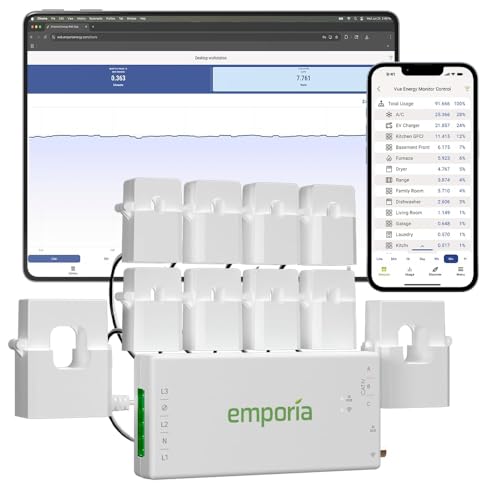
- UL Listed and CE Listed
- Tracks real-time usage with ±2% accuracy
- Supports solar, net metering, and automation
Best For: Homeowners who want UL-listed monitoring with solar support
Multi-Circuit Value
16-Sensor Smart Energy Monitor

- Includes 16 50A circuit sensors
- Supports app history and cost tracking
- Can run locally with MQTT and no cloud
Best For: Rental homes and shared spaces needing many circuit sensors
Appliance Tracking
Emporia Vue 3 with 16 Branch Sensors
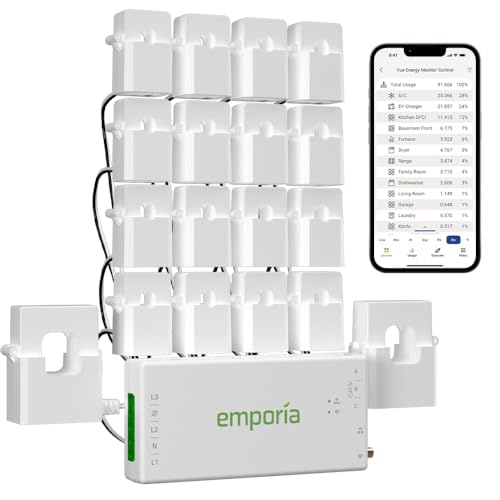
- Sixteen branch sensors included
- UL Listed and CE Listed
- Tracks appliances like HVAC, water heater, and dryer
Best For: Homes that want whole-home monitoring plus appliance-level detail
Panel-Level Control
Siemens Inhab Smart Energy Monitor

- Tracks mains and up to 16 branch circuits
- Includes alerts and advanced energy management
- UL Listed and CE marked
Best For: Homeowners who want monitoring plus control and alerts
Local-First Whole House Monitor
Refoss Smart Home Energy Monitor

- No-cloud local control with Web UI, Open API, and MQTT
- Native Home Assistant plus OpenClaw AI support
- Solar net metering and surplus automation for home loads
Best For: Privacy-focused smart homes and solar automation
Solar-Ready Circuit Monitor
Meross Smart Home Energy Monitor

- Tracks 2 main circuits and 16 branch circuits
- Home Assistant support with solar surplus detection
- Local data, no subscriptions, and smart alerts
Best For: Solar homes and detailed circuit-level monitoring
Cloud-Connected Home Meter

- Whole-home, solar, and net-metering monitoring
- MyEyedro cloud with reports and history
- WiFi or Ethernet with two 200A sensors
Best For: Homeowners wanting simple cloud-based monitoring
Pro-Level Circuit Detail
Meross 18-Circuit Energy Monitor
- Monitors 18 circuits with 2 main 200A and 16 branch sensors.
- Stores up to 5 years of local data with no subscription.
- Home Assistant support helps automate solar surplus and loads.
Best For: Detailed circuit-level monitoring with local privacy and Home Assistant automation.
Bundle Convenience
Emporia Whole Home Monitor + Smart Plugs

- Includes the Vue monitor with 16 sensors plus 4 smart plugs.
- Free app supports trends, automations, and real-time control.
- Works with solar net metering and time-of-use management.
Best For: All-in-one monitoring plus outlet control and app automation.
Private Power Analytics
Refoss Local Data Energy Monitor
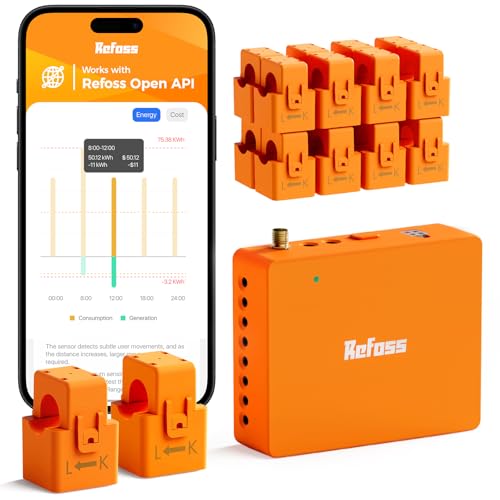
- Tracks 18 circuits with ±1% precision and smart alerts.
- Keeps data local with web UI, Open API, MQTT, and WebSocket.
- Stores 5 years of daily data and supports CSV export.
Best For: Privacy-minded households that want local analytics and solar automation.
Editor’s Pick – Emporia Vue 3 Whole-Home Monitor
If you want a whole house energy monitor that focuses on safety and actionable savings, the Emporia Vue 3 is built for that job. It installs in most circuit panels with clamp-on sensors, tracks real-time usage, and also supports solar and net metering, so it works well for homes trying to understand both consumption and production.
Best For: Homeowners who want UL-listed monitoring with solar and net metering support.
Pros:
- UL Listed and CE Listed for added safety confidence
- Monitors real-time electricity use with ±2% sensor accuracy
- Supports solar / net metering and automation for time-of-use or peak demand
- Works with iPhone, Android, and web app on 2.4 GHz WiFi
Cons:
- Requires 2.4 GHz WiFi and an internet connection
- 3-phase, 4-wire Wye setups need an additional 200A sensor sold separately
- Some higher-resolution data is limited by app/cloud retention windows
Overall, this is a strong choice if you want dependable whole-home monitoring with clear app access and safety certifications. It balances everyday energy tracking with features that can help lower bills over time.
Multi-Circuit Value – 16-Sensor Smart Energy Monitor
This whole house energy monitor is geared toward users who want detailed circuit-level insight without giving up flexible deployment. With 16 included 50A sensors, it can track major appliances, and it also supports solar / net metering plus real-time cost tracking through the app.
Best For: Rental homes, shared apartments, and owners who need many circuit sensors.
Pros:
- Includes 16 50A sensors for detailed appliance and circuit monitoring
- Supports single-phase, split-phase, and three-phase systems
- Offers real-time usage, cost tracking, and usage history in the app
- Can run in LAN/MQTT setups with no cloud required
Cons:
- Home Assistant with MQTT is required for the privacy-mode setup
- Requires 2.4 GHz WiFi for standard app connectivity
- Panels with busbar-only access may need flexible sensors sold separately
For buyers who need more circuit coverage than a basic monitor, this model stands out with its sensor count and privacy options. It’s especially practical when you want separate visibility for multiple rooms, appliances, or shared living arrangements.
Appliance Tracking – Emporia Vue 3 with 16 Branch Sensors
For shoppers comparing a whole house energy monitor that also digs into specific appliances, this Emporia Vue 3 version adds 16 branch sensors for more granular tracking. It’s designed for circuit-panel installation and can monitor critical loads like the air conditioner, furnace, water heater, washer, dryer, and range.
Best For: Homes that want whole-home monitoring plus broader circuit-by-circuit visibility.
Pros:
- Comes with sixteen 50A branch sensors for appliance-level monitoring
- UL Listed and CE Listed for safety
- Supports solar / net metering and energy management features
- Works with iPhone, Android, and web app over 2.4 GHz WiFi
Cons:
- Requires 2.4 GHz WiFi with internet connection
- 3-phase, 4-wire Wye systems need an additional 200A sensor sold separately
- Best app data retention depends on the cloud rather than local storage
This is a sensible choice if you want the Emporia platform but need more branch-level visibility than a basic package provides. It combines safety certification, live monitoring, and flexible load tracking in one panel-based system.
Panel-Level Control – Siemens Inhab Smart Energy Monitor
The Siemens Inhab is a whole house energy monitor for buyers who want panel-level measurement plus built-in management features. It tracks current and historical usage in real time, measures energy directly at the mains and up to 16 branch circuits, and adds alerts for abnormal behavior and savings opportunities.
Best For: Homeowners who want whole-home monitoring with advanced control features and alerts.
Pros:
- Measures both mains and up to 16 branch circuits directly
- Offers personalized alerts for energy savings and unusual usage
- Supports Time of Use, Peak Demand, Excess Solar, and Net Metering management
- UL Listed and CE marked for compliance confidence
Cons:
- USA and Canada only for the mobile app
- Not a simple read-only monitor if you only want basic usage data
- Smart-device load shedding is limited to compatible devices
As a whole-home monitor, the Inhab stands out when you want more than charts and history. Its mix of monitoring, notifications, and advanced energy functions makes it a good fit for households trying to actively manage usage.
Local-First Whole House Monitor – Refoss Smart Home Energy Monitor
If you want a whole house energy monitor that keeps data inside your home network, the Refoss model stands out for local control, real-time tracking, and deep smart-home integration. It’s built for homeowners who want circuit-level visibility without depending on the cloud.
Best For: Privacy-focused smart homes, Home Assistant users, and solar households that want local automation.
Pros:
- Local access through built-in Web UI, Open API, and MQTT with no cloud requirement.
- Native Home Assistant support plus OpenClaw AI support for automation.
- Supports solar net metering and surplus solar automation for EV chargers, washers, and water heaters.
- Real-time monitoring with ±1% accuracy, long-term data storage, and no subscription fees.
Cons:
- Best value depends on whether you will actually use the local API and automation features.
- Requires panel installation and clamp-on sensor setup.
The Refoss is a strong pick if local control matters more than app-only convenience. Its mix of privacy, Home Assistant support, and solar-focused automation makes it a capable monitoring hub for energy-conscious homes.
Solar-Ready Circuit Monitor – Meross Smart Home Energy Monitor
The Meross whole house energy monitor is aimed at homeowners who want circuit-level visibility, local data handling, and solar surplus detection in one package. It tracks usage in real time and adds smart alerts that can help you spot spikes before they become expensive problems.
Best For: Solar homes, Home Assistant setups, and buyers who want 18-circuit monitoring with local privacy.
Pros:
- Monitors 2 main circuits plus 16 branch circuits for detailed whole-home insight.
- Home Assistant support with solar surplus detection for EV chargers and water heaters.
- Local data, no subscriptions, and support for Open API and Web Control.
- ETL-certified, UL 61010 compliant, with a 2-year warranty.
Cons:
- Only compatible with specific US electrical system types.
- Panel installation still requires clamp-on sensor setup.
For buyers who want a practical energy monitor with strong solar and smart-home features, Meross is a well-rounded option. Its combination of local privacy, detailed circuit tracking, and alerting makes it especially useful for managing everyday energy use.
Cloud-Connected Home Meter – Eyedro Home Energy Monitor
The Eyedro home energy monitor is a straightforward whole house energy monitor for homeowners who want real-time visibility into electricity use and solar generation. It focuses on simple tracking through the MyEyedro cloud, with reports and history that make it easier to understand where power is going.
Best For: Homeowners who want an easy-to-read cloud dashboard for whole-home or solar monitoring.
Pros:
- Works as a whole home monitor, solar meter, or net metering setup.
- Shows usage in dollars, watts, amps, and volts through MyEyedro.
- Includes two 200A sensors plus WiFi or Ethernet connectivity.
- No subscription required and built to meet North American safety standards.
Cons:
- Cloud-based monitoring may not suit buyers looking for fully local control.
- Single EYEDRO-HOME cannot monitor grid and solar separately at the same time.
Eyedro is a solid choice if you want a proven monitoring system with clear reports and flexible connectivity. It’s less feature-heavy than some smart-home-first options, but it does the basics well for households focused on visibility and savings.
Pro-Level Circuit Detail – Meross 18-Circuit Energy Monitor
If you want a whole house energy monitor with true circuit-level visibility, the Meross model is built for deep tracking rather than basic whole-home estimates. It monitors 2 main circuits plus 16 branch circuits, shows real-time power data, and keeps all energy information local with no subscription required.
Best For: Homeowners who want detailed circuit monitoring, local data privacy, and Home Assistant-based automation.
Pros:
- Tracks 18 circuits total, including 2 main 200A circuits and 16 branch circuits.
- Supports minute/hour/day/month/year charts and up to 5 years of stored data.
- Built-in smart alerts help flag unusual spikes and threshold breaches.
- Works with Home Assistant and supports local data, Open API, and web control.
Cons:
- Best fit for buyers who need circuit-by-circuit monitoring, not a simple plug-and-play meter.
- No cloud app ecosystem is highlighted, so it is less oriented toward app-first convenience.
This is a strong choice if your priority is accurate, private energy monitoring with automation potential. The Meross monitor stands out for its local-first design, solar-focused Home Assistant support, and the kind of data depth that helps you identify energy hogs and cut waste.
Bundle Convenience – Emporia Whole Home Monitor + Smart Plugs
This whole house energy monitor bundle is aimed at buyers who want monitoring and control in one package. Along with the Emporia Vue monitor and 16 sensors, it includes 4 smart plugs so you can track and automate plugged-in devices from the same app.
Best For: Buyers who want a bundled energy monitor with outlet-level control and app-based automation.
Pros:
- Includes 16 sensors for main-panel and circuit tracking plus 4 smart plugs.
- Offers second-by-second visibility and real-time device control.
- Free iOS and Android app supports trends, automations, and notifications.
- Supports solar net metering, time-of-use, peak demand, and reward programs.
Cons:
- Cloud storage is part of the experience, which may not suit buyers seeking fully local data.
- Bundle focus may be more than you need if you only want panel monitoring.
The Emporia bundle is practical if you want to monitor your home and directly control a few devices without buying separate hardware. It is especially appealing for users who value the included smart plugs and broad app support over a local-only setup.
Private Power Analytics – Refoss Local Data Energy Monitor
For shoppers comparing a whole house energy monitor with a privacy-first design, the Refoss unit puts local control front and center. It offers 18-circuit monitoring, local web UI access, Open API and MQTT support, and detailed usage history for households that want to analyze electricity costs without depending on cloud services.
Best For: Privacy-minded users who want local energy data, exportable analytics, and solar-aware automation.
Pros:
- Monitors 18 individual circuits with professional ±1% precision.
- Stores data locally and supports Local Web UI, Open API, MQTT, and WebSocket.
- Works with Home Assistant via Refoss_RPC for cloud-free control.
- Includes smart alerts and 5 years of daily data storage with CSV export.
Cons:
- Its strongest appeal is to advanced users who will use the local control tools.
- The feature set is broad, so setup may be more involved than simpler monitors.
The Refoss monitor is a smart pick if you want serious analytics without giving up privacy. It combines precise circuit tracking, local integrations, and solar-focused energy management in a package designed for long-term household optimization.
How We Picked the Best Whole House Energy Monitor
We prioritized monitors that provide clear whole-home visibility, reliable circuit-level data, and practical app or web access. We also looked for installation flexibility, solar or net-metering support where relevant, and ecosystem compatibility such as Home Assistant or local APIs.
Quick Comparison
The best choice depends on how much detail you want. Some systems are built for straightforward household tracking, while others add more sensors for branch-circuit analysis, smart-plug control, or privacy-friendly local storage. If you want a simple energy dashboard, a lighter setup may be enough. If you need deeper insight into individual circuits, choose a monitor with more sensors and stronger expansion options.
Key Buying Factors for a Whole House Energy Monitor
Sensor Count and Coverage
More sensors usually mean better visibility into specific loads like HVAC, laundry, EV charging, or solar production. Check whether the system includes main clamps only or both main and branch-circuit sensors.
App, Web, and Data Access
Good software matters as much as the hardware. Look for clear real-time charts, energy history, cost tracking, and export options. If privacy is important, local storage, open APIs, or web UI access can be major advantages.
Solar Compatibility
If you have solar panels, make sure the monitor supports net metering or solar surplus tracking. This helps you understand both consumption and generation instead of only household usage.
Installation and Electrical Fit
Confirm compatibility with your panel type, breaker space, and service rating. Some systems are designed for easier residential installs, while others are better suited to larger or more complex panels.
Smart Home Integration
If you already use Home Assistant or other automation platforms, choose a monitor that integrates cleanly so you can build alerts, automations, and custom dashboards.
Who Should Buy Which Whole House Energy Monitor?
Choose a simple Whole House Energy Monitor if you mainly want lower bills and basic usage awareness. Pick a circuit-level model if you want to identify specific energy hogs or compare room-by-room loads. If privacy or offline control matters most, a local-data or open-API option is the better fit. For solar homeowners, prioritize monitors with generation and surplus tracking so you can see the full energy picture.