Fresh pasta is easier to make at home when you have the right machine for your kitchen, cooking habits, and available prep time. The models in this roundup include traditional manual rollers, compact electric machines, and automatic options that handle more of the mixing and shaping.
Whether you want reliable lasagna sheets, quick spaghetti, or multiple pasta shapes with minimal effort, this guide highlights the features that matter most before you buy.
Best 10 Pasta Machines for Home Bakers Picks for 2026
Best Italian-Made Classic
MARCATO Atlas150 Manual Pasta Maker

- Italian-made chrome-steel construction
- 10 thickness settings from 0.8 to 4.8 mm
- Makes lasagna, fettuccine, and tagliolini
Best For: Traditional pasta making with precise manual control
Best Budget-Friendly Versatility

- Nine thickness settings from 0.5 to 3 mm
- Two cutter widths for varied pasta shapes
- Lightweight stainless steel manual design
Best For: Beginners and families making varied fresh pasta
Best Automatic Option
VEVOR 150W Electric Pasta Maker

- Four automatic modes for easier preparation
- 500 g capacity for roughly four servings
- Eight discs and dishwasher-safe parts
Best For: Convenient automated pasta making for beginners and families
Best Simple Manual Starter

- Seven thickness settings from 0.5 to 3 mm
- Two cutters for 2 mm and 6 mm noodles
- Stainless steel manual construction
Best For: Straightforward pasta and dumpling-wrapper making
Best All-in-One Pick
Philips 7000 Series Pasta Maker

- Makes up to eight portions in under 10 minutes
- Eight discs support varied pasta shapes
- Mixing function also handles cookie and bread prep
Best For: Families wanting an automatic, high-capacity pasta maker
Best Compact Stainless-Steel Value

- Two automatic noodle formats for everyday use
- Eight thickness settings from 0.5 to 3 millimeters
- Stainless-steel construction with low-noise operation
Best For: Beginners making noodles, pasta sheets, and wrappers at home
Best Roller-and-Cutter Design

- Three-in-one roller, fettuccine, and spaghetti setup
- Eight thickness settings with two speeds and reverse
- Stainless-steel housing and metal drive gears
Best For: Home cooks wanting powered rolling with hands-on control
Best for Beginners

- Four automatic modes simplify preparation
- 500g capacity serves about four people
- Eight molds offer varied pasta shapes
Best For: Beginners and families wanting convenient automatic noodle making
Best Electric Roller
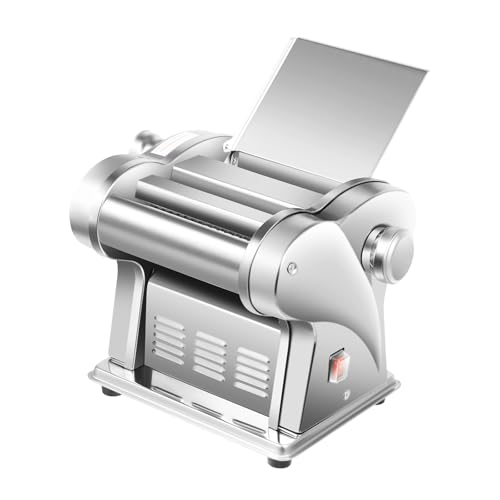
- 135W motor powers pressing and cutting
- Eight gears adjust thickness from 0.5mm to 3.5mm
- Two cutters make 2mm and 4mm flat noodles
Best For: Home cooks wanting powered dough rolling with adjustable thickness
Best Italian-Made Classic – MARCATO Atlas150 Manual Pasta Maker
MARCATO Atlas150 Manual Pasta Maker Machine-LASAGNA, FETTUCCINE & TAGLIOLINI. Made in Italy
Check Price On AmazonFor home bakers seeking traditional control, the MARCATO Atlas150 is a manual pasta machine for home bakers with 10 settings and three included pasta formats: lasagna, fettuccine, and tagliolini. Its chrome-plated steel construction provides a sturdy, classic setup for rolling and cutting fresh dough.
Best For: Home cooks who want a traditional Italian-made machine with fine thickness control.
Pros:
- Made in Italy with chrome-plated steel construction.
- Offers 10 settings, from 0.8 mm to 4.8 mm.
- Includes cutters for lasagna, fettuccine, and tagliolini.
Cons:
- Manual operation requires hands-on rolling and cutting.
- The listed 2.6 kg weight may make storage and setup less convenient than lighter models.
The Atlas150 suits bakers who value precise manual adjustment and classic pasta-making formats. It is a focused choice rather than an automatic or highly versatile extruding machine.
Best Budget-Friendly Versatility – Sailnovo 3-in-1 Pasta Maker
The Sailnovo is a practical pasta machine for home bakers who want adjustable rolling and multiple noodle widths without an electric motor. Its nine-position roller reaches 0.5 to 3 mm, while the cutters produce 2.0 mm or 4.5 mm noodles for dishes such as spaghetti, fettuccine, and lasagna.
Best For: Beginners and families looking for a lightweight manual machine with broad everyday versatility.
Pros:
- Provides nine thickness settings, including thin dumpling-wrapper settings.
- Includes two cutting widths for different pasta styles.
- Stainless steel construction is described as rust-resistant and lightweight.
- Comes with a clamp and English manual.
Cons:
- The blade attachment should not be washed in water or placed in a dishwasher.
- Manual operation requires repeated rolling and cutting.
With its flexible thickness range and two cutter widths, the Sailnovo offers a useful starting point for homemade pasta. Careful dry cleaning of the blade attachment is important for maintaining it.
Best Automatic Option – VEVOR 150W Electric Pasta Maker
The VEVOR electric pasta maker is a convenient pasta machine for home bakers who prefer automated mixing, kneading, and extrusion. Its 500 g flour capacity, four automatic modes, and eight pasta discs are designed to produce fresh noodles with minimal hands-on work.
Best For: Busy home cooks and beginners who want automatic noodle making for batches of about four people.
Pros:
- Four automatic modes simplify the pasta-making process.
- 500 g flour capacity can make noodles for about four people in approximately 14 minutes.
- Includes eight discs for different pasta shapes.
- Parts are dishwasher-safe and a cleaning brush and spatula are included.
Cons:
- Correct flour-to-water ratios are important to prevent sticking or failed extrusion.
- At 11 pounds, it is heavier than the listed manual alternatives.
- Its 13.4-by-7.1-by-11-inch footprint requires dedicated storage space.
The VEVOR is the strongest fit for convenience-focused users who want to reduce manual kneading and shaping. Its automated workflow is appealing, but following the included ratio guidance is essential.
Best Simple Manual Starter – Nuvantee 3-in-1 Pasta Maker
The Nuvantee is a straightforward pasta machine for home bakers who want manual control over dough thickness and noodle width. Its seven settings cover 0.5 to 3 mm, and the two included cutters make 2 mm spaghetti or 6 mm fettuccini for pasta, lasagna, and dumpling wrappers.
Best For: Home cooks who want a simple stainless steel machine for core pasta and dumpling projects.
Pros:
- Uses a 100% premium-grade stainless steel construction according to the supplied product notes.
- Offers seven thickness settings from 0.5 to 3 mm.
- Includes dedicated 2 mm and 6 mm cutting attachments.
- Manual design is described as accessible for kids and seniors.
Cons:
- Manual operation requires hands-on effort.
- Provides two cutter widths, fewer than some machines with broader cutting options.
- The listed dimensions may require careful storage planning.
Nuvantee keeps the feature set focused and approachable, making it suitable for standard fresh pasta and dumpling-wrapper tasks. It is a sensible choice when simplicity matters more than automation or numerous attachments.
Best All-in-One Pick – Philips 7000 Series Pasta Maker
For home bakers seeking pasta machines for home bakers that can handle more than noodles, the Philips 7000 Series combines automatic mixing and extrusion with a generous capacity. It can prepare up to eight portions in under 10 minutes, while its mixing function also supports cookie dough and the early preparation of pizza and bread.
Best For: Families and home cooks who want high-capacity, guided pasta making with versatile dough-mixing capabilities.
Pros:
- Prepares fresh pasta in under 10 minutes and makes up to eight portions.
- Includes eight discs for varied pasta shapes.
- Dishwasher-safe, non-stick parts simplify cleanup.
- HomeID app offers step-by-step recipes, including vegan and gluten-free options.
Cons:
- At 20 pounds, it is relatively heavy for a countertop appliance.
- Its 12.87-by-9.02-by-12.68-inch footprint may require dedicated storage space.
This is the strongest choice when capacity, automation, and recipe variety matter more than a compact design. Its eight discs and broader mixing function give it more range than a basic roller-and-cutter machine.
Best Compact Stainless-Steel Value – Newhai Electric Pasta Maker
Among pasta machines for home bakers, the Newhai Electric Pasta Maker is a straightforward countertop option for everyday noodle making. Its automatic operation presses dough and cuts two noodle styles, while eight thickness settings also let it prepare wrappers and other thin dough sheets.
Best For: Home users who want a relatively compact electric machine for spaghetti, flat noodles, pasta sheets, dumpling wrappers, and wonton wrappers.
Pros:
- Adjustable dough thickness ranges from 0.5 to 3 millimeters.
- Produces 1.5-millimeter round noodles and 4-millimeter flat noodles.
- Stainless-steel body, rollers, and blades resist rust and provide food-contact surfaces.
- One-key switching between pressing and cutting supports simple operation.
Cons:
- Only two noodle sizes are included.
- It is intended for home use rather than commercial production.
- Very thin dough may not cut through cleanly.
The Newhai favors practical daily use over shape variety. It is a sensible pick for beginners who mainly want two noodle formats and adjustable sheets without moving up to a larger, more feature-rich machine.
Best Roller-and-Cutter Design – GVODE Electric Pasta Maker
For home bakers comparing pasta machines for home bakers, the GVODE Electric Pasta Maker offers an electric roller-and-cutter setup without requiring a stand mixer. Its stainless-steel roller, eight thickness settings, two speeds, and reverse function provide useful control for preparing sheets, fettuccine, and spaghetti.
Best For: Kitchen enthusiasts who prefer an electric roller-and-cutter machine with multiple thickness settings and a reverse function.
Pros:
- Three-in-one attachment includes a sheet roller, fettuccine cutter, and spaghetti cutter.
- Eight thickness settings cover approximately 0.4 to 2 millimeters.
- Two speeds and reverse help manage dough during operation.
- Stainless-steel housing and metal drive gears are designed for regular home use.
Cons:
- Recommended 15-minute batches require a five-minute cool-down.
- It is semi-automatic and does not extrude pasta shapes like a fully automatic pasta maker.
- The dough needs progressive rolling for the cleanest cuts.
The GVODE is a good fit when you want powered rolling and cutting with hands-on control. Its reverse function and broad thickness range add convenience, but the batch-and-cooldown guidance makes it better suited to home cooking than continuous production.
Best Manual Control – Stainless Steel Adjustable Pasta Maker
For home bakers comparing pasta machines for home bakers, this manual stainless steel model offers hands-on control over dough thickness and noodle width. Its seven thickness settings and dual cutter head support spaghetti, fettuccine, lasagna sheets, and other homemade pasta styles.
Best For: Home cooks who prefer manual operation, adjustable thickness, and compact storage.
Pros:
- Seven thickness settings provide flexibility for different pasta styles.
- Dual cutter head makes both spaghetti and fettuccine.
- Detachable handle and clamp simplify storage and countertop setup.
- Heavy-duty stainless steel construction with a stainless steel blade.
Cons:
- Manual operation requires more hands-on effort than an electric machine.
- Its two cutter options may be less versatile than an extruder with multiple pasta shapes.
This is a practical choice if you want traditional pasta-making control without a motor. The adjustable settings and removable parts make it suitable for cooks balancing versatility with limited storage space.
Best for Beginners – VEVOR Automatic Pasta Maker
This VEVOR model is a convenient option for home bakers seeking pasta machines for home bakers with minimal manual work. Its automatic modes, 500-gram flour capacity, and eight pasta discs are designed to help beginners make fresh noodles in batches for roughly four people.
Best For: Beginners and families who want automatic preparation and multiple noodle shapes.
Pros:
- Four automatic modes simplify mixing and noodle making.
- 500-gram flour capacity can produce enough noodles for about four people.
- Eight molds provide a broad range of pasta shapes.
- Includes measuring cups, a spatula, cleaning brush, and dishwasher-safe parts.
Cons:
- Correct flour-to-water ratios are important to prevent sticking or failed extrusion.
- At 11 pounds, it is heavier than a basic manual pasta roller.
Choose this machine when convenience and variety matter more than traditional rolling. The included accessories and automatic operation lower the learning curve, although careful measuring remains essential.
Best Electric Roller – 135W Automatic Pasta Maker
For shoppers evaluating pasta machines for home bakers, this 135W electric model combines motorized operation with adjustable dough thickness. It presses sheets up to 5.51 inches wide, offers eight thickness gears, and includes two cutters for 2mm and 4mm flat noodles.
Best For: Home cooks who want powered dough pressing with adjustable sheet thickness and compact dimensions.
Pros:
- 135W motor supports powered dough pressing and noodle cutting.
- Eight gears adjust sheet thickness from 0.5mm to 3.5mm.
- Double cutter design makes two flat noodle widths.
- Compact 10.24-by-8.07-by-8.46-inch footprint aids storage.
Cons:
- It offers fewer pasta-forming options than a machine with multiple extrusion discs.
- The 14.8-pound weight may make frequent repositioning less convenient.
This machine suits cooks who want the consistency of electric pressing while retaining control over dough thickness. Its compact footprint is useful for smaller kitchens, but the design is focused primarily on sheets and flat noodles.
How We Picked the Best Pasta Machines for Home Bakers
We focused on the practical differences that affect everyday pasta making: machine type, roller or cutter options, thickness adjustment, capacity, construction, cleaning, and ease of use. The selection includes established manual designs as well as electric and automatic machines for cooks who want faster preparation or less hands-on work.
We also considered versatility. A machine that produces several useful shapes may be a better choice for varied meals, while a straightforward roller-and-cutter set can be preferable for beginners who mainly make sheets, fettuccine, or spaghetti.
Quick Comparison
| Machine type | Best for | Main advantage | Potential trade-off |
|---|---|---|---|
| Manual roller | Traditional pasta makers and occasional use | Simple, durable, and easy to control | Requires hand cranking and counter space |
| Electric roller or cutter | Faster batches with less effort | Reduces manual work | Needs an outlet and may be noisier |
| Automatic pasta maker | Convenience-focused households | Mixes, kneads, and extrudes with minimal intervention | More parts to clean and maintain |
Key Buying Factors for Pasta Machines for Home Bakers
Manual or Automatic Operation
Manual machines offer direct control over dough thickness and are often easier to understand and store. Electric and automatic models make sense if you prepare pasta frequently, have limited hand strength, or want the machine to handle mixing and shaping.
Adjustability and Pasta Shapes
Look for multiple thickness settings if you plan to make delicate sheets, ravioli, lasagna, or different noodle styles. Check whether the listed cutters or shaping discs match the pasta you actually cook; more attachments are not always more useful.
Capacity and Consistency
Consider how much dough you typically prepare in one session. Larger-capacity electric machines can suit families, while smaller machines may be easier to store. Consistent extrusion or rolling is especially important when making several portions.
Cleaning, Storage, and Stability
Removable components can simplify cleanup, but always check whether parts are intended for hand washing. Manual machines need a stable clamp or base, while electric models need a convenient counter location and safe cord storage.
Who Should Buy Which Pasta Machines for Home Bakers?
Choose a manual machine if you enjoy the traditional process, want precise control, or make pasta occasionally. It is also a practical starting point for learning dough hydration and rolling technique.
Choose an electric roller-and-cutter model if you want quicker shaping without giving up control over the dough. These machines suit frequent cooks who already have a preferred dough recipe.
Choose an automatic machine if convenience is your priority and you want the appliance to mix, knead, and form pasta. This category is especially useful for busy households, larger batches, and users who prefer a guided process.
Before ordering, verify the machine’s voltage, included attachments, countertop dimensions, and cleaning instructions. The best Pasta Machines for Home Bakers are the ones that fit your routine well enough to use regularly.