Healthy indoor plants need more than a bright-looking window. The right grow light can provide consistent intensity, useful coverage, and a dependable schedule when natural sunlight is limited.
We selected 10 grow lights for different spaces and budgets, from compact bulbs and clip-on lamps to full-size fixtures designed for grow tents. Use the guide below to match light type, coverage, controls, and power to your plants.
Best 10 Grow Lights Picks for 2026
Best Overall Coverage

- Full-spectrum lighting for every growth stage
- Dimmable, fanless panel with aluminum heat dissipation
- Daisy-chains up to 20 units
Best For: Medium-sized indoor growing areas and multi-light setups
Best for Grow Tents

- Fits 2-by-2, 2-by-3, and 2-by-4-foot tents
- Full spectrum supports all growth stages
- Separate VEG and BLOOM modes
Best For: Tent growers wanting compact, adjustable lighting
Best for Plant Shelves

- Six 4-foot, 5000K full-spectrum LED bars
- Linkable design with mounting accessories
- Aluminum housing supports heat dissipation
Best For: Shelves, racks, seedlings, and larger indoor stations
Best Single-Bulb Option

- BR30 bulb with a standard E26 base
- 4000K full-spectrum daylight output
- Ceramic body with ETL listing and five-year warranty
Best For: Individual plants and small indoor growing areas
Best Vertical Grow Light

- Adjustable 4–5.6-foot height
- Full spectrum with 660nm red chips
- Freestanding design with timer
Best For: Tall indoor plants and large plant shelves
Best Clip-On Grow Lights
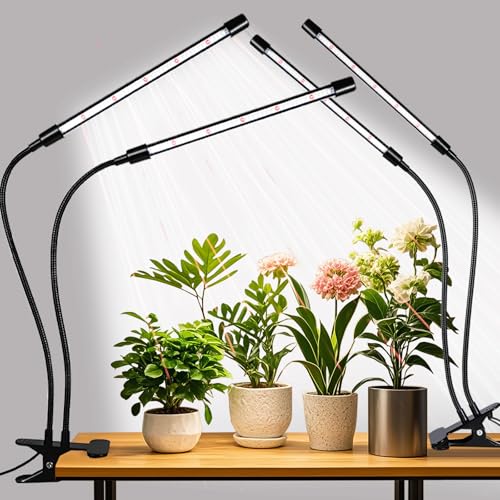
- Four flexible heads across two lights
- Three modes and ten brightness levels
- Automatic 3/9/12-hour cycle timer
Best For: Small plant groups and shelves
Best Grow Light Bulbs

- Standard E26 screw-in base
- 1000 lumens using 11W
- Natural-looking white full spectrum
Best For: Existing indoor lamps and standard sockets
Flexible Halo Pick
Adjustable Full-Spectrum Grow Light

- Three modes and 10 brightness levels
- Adjustable pole reaches up to 26 inches
- Repeating 3, 9, or 12-hour timer
Best For: Small indoor plant displays and individual pots
High-Output Choice
VIVOSUN LumaLight 100W LED Grow Light
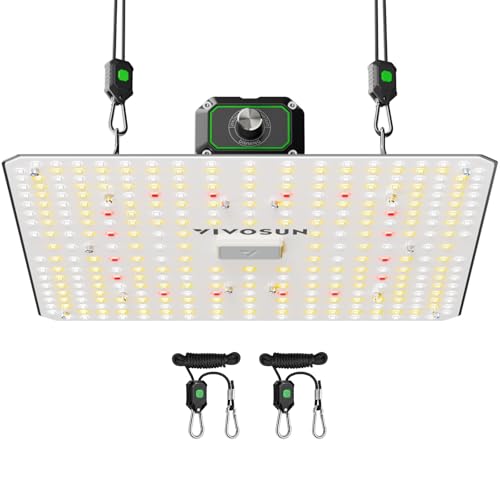
- 100-watt full-spectrum LED array
- Four-level dimming from 25% to 100%
- IP65 waterproof and dustproof design
Best For: Larger indoor growing areas and humid environments
Multi-Head Value
LEOTER 80-LED Adjustable Grow Light
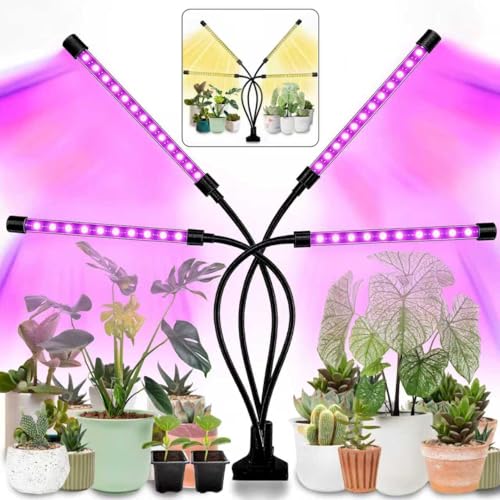
- Four flexible, 360-degree adjustable heads
- Three spectrum modes and 10 dimming levels
- Repeating 3-, 9-, or 12-hour timer
Best For: Small plant groups in homes or offices
Best Overall Coverage – VIPARSPECTRA P2000 Grow Light
For growers who want versatile grow lights for seedlings through flowering, the VIPARSPECTRA P2000 combines a full spectrum, adjustable brightness, broad coverage, and passive cooling in a rectangular panel.
Best For: Indoor growers needing adjustable, full-cycle lighting for medium-sized growing areas or connected multi-light setups.
Pros:
- Full spectrum includes 660nm red, 3000K, and 5000K white light for all growth stages.
- Dimming knob allows brightness adjustments, including completely switching the light off.
- Fanless aluminum heat-sink design supports quiet operation and heat dissipation.
- Daisy-chain capability supports connecting up to 20 P2000 lights.
Cons:
- Its 23.6-inch panel may be more light than needed for a small plant shelf.
- Coverage depends on adjusting height and brightness correctly for the plants.
With a three-year warranty, dimming, and stated coverage of up to 4 by 3 feet for vegetation, this is a flexible choice for growers who want one panel to handle multiple stages.
Best for Grow Tents – BESTVA DC1000 Grow Light
The BESTVA DC1000 is a compact grow light designed around tent-friendly coverage. Its full-spectrum LEDs, separate VEG and BLOOM modes, and hanging format make it practical for staged indoor growing.
Best For: Growers using 2-by-2, 2-by-3, or 2-by-4-foot tents who want switchable lighting modes.
Pros:
- Designed to fit several common grow-tent sizes.
- Full spectrum combines 3000K and 5000K white LEDs with 460nm blue and 660nm red light.
- VEG and BLOOM modes let growers tailor the light to different stages.
- Its design supports light penetration into light to moderately dense canopies.
Cons:
- Very dense canopies may still need side or in-canopy lighting.
- Plants with higher light needs may require a higher-output model.
The DC1000’s compact 12.2-by-8.46-inch body and three-year warranty suit growers who want a straightforward hanging fixture for a tent, with height and mode adjustments available as plants develop.
Best for Plant Shelves – Barrina 4FT Grow Light 6-Pack
These Barrina grow lights are long, 4-foot LED bars made for spreading daylight-style illumination across shelves, racks, greenhouses, and other indoor growing spaces. The six-light package is especially useful when coverage matters more than a single concentrated panel.
Best For: Plant shelves, seedling areas, grow racks, and indoor spaces that benefit from linked bar lighting.
Pros:
- Six 4-foot, 5000K full-spectrum bars provide broad linear coverage.
- V-shaped reflectors are designed to increase light efficiency and intensity.
- Bars can be linked in series, with included clips, tape, and cable ties for installation.
- Aluminum construction helps dissipate heat.
Cons:
- The bars are for indoor use and are not water resistant.
- Connecting new and older Barrina products may require the specified connector cables.
- The six-bar kit may be excessive for a single small plant.
With included mounting hardware and three switched power cords, this kit offers a convenient way to outfit multiple shelves or a larger growing station with consistent 5000K light.
Best Single-Bulb Option – SANSI 36W Grow Light
For a simple fixture upgrade, the SANSI 36W grow light uses a BR30 E26 bulb format and natural-looking 4000K daylight. Its compact form makes it easier to add grow-light support to an existing indoor lamp or socket.
Best For: Individual indoor plants and small growing areas that use a standard E26 socket.
Pros:
- Standard E26 BR30 bulb format works with compatible sockets.
- 4000K full-spectrum daylight covers the visible 400nm-to-780nm range.
- Optical lens design is intended to improve light distribution and PPFD.
- Ceramic construction supports heat transfer, while the bulb carries ETL listing and a five-year warranty.
Cons:
- A single bulb is less suitable for broad shelves or dense plant canopies.
- It requires a compatible lamp or socket rather than serving as a complete hanging panel.
The SANSI is a practical choice when you want focused supplemental lighting without installing a multi-bar system, particularly for a houseplant or small indoor growing area.
Best Vertical Grow Light – Barrina T10 Pro 42W
The Barrina T10 Pro is a practical choice among grow lights for tall houseplants, large plant shelves, and indoor displays. Its freestanding vertical design, adjustable height, full-spectrum output, and included mechanical timer make it easy to position and schedule.
Best For: Tall indoor plants, large shelves, and growers who want broad, upright coverage.
Pros:
- Adjusts from 4 to 5.6 feet for taller plants and shelving.
- 42W full-spectrum LED output includes 660nm red wavelength chips.
- Wide side-lighting coverage with a freestanding, tool-free assembly.
- Includes a mechanical timer and foot control.
Cons:
- Designed for indoor use and is not waterproof.
- Its floor-standing format requires available space beside the plants.
The adjustable height and wide vertical coverage make this a strong fit when a small clip light cannot reach an indoor plant canopy. Choose it if you value a clean floor-lamp style and simple scheduling over a compact setup.
Best Clip-On Grow Lights – 168-LED Gooseneck 2-Pack
This two-pack offers flexible grow lights for indoor plants when you need targeted illumination without adding a floor stand. Four adjustable gooseneck heads, sturdy clips, three spectral modes, and ten brightness levels make it easy to direct light across multiple pots.
Best For: Small plant groupings, shelves, and flexible placement around a desk or tabletop.
Pros:
- Two light units provide four adjustable heads in total.
- Includes full-spectrum, white, and red-light modes.
- Offers ten dimming levels for different growth stages.
- Cycle timer supports automatic 3-, 9-, or 12-hour operation.
Cons:
- Clip-on mounting is better suited to reachable surfaces than open floor areas.
- Requires positioning the goosenecks close enough to the plants for targeted coverage.
The flexible heads and independent placement make this set more adaptable than a single fixed lamp. It is a useful option for indoor gardeners who want to spread light over several plants and avoid daily manual switching.
Best Grow Light Bulbs – A19 Full-Spectrum E26
These A19 grow light bulbs are a straightforward way to add grow lights to an existing indoor fixture. With standard E26 bases, 1000-lumen output, a natural-looking white appearance, and low 11W power consumption, they can fit into a regular lamp or socket.
Best For: Indoor gardeners who already have standard E26 fixtures and want discreet supplemental lighting.
Pros:
- Standard E26 base makes installation simple in compatible fixtures.
- Full-spectrum light is designed for plants at different growth stages.
- Produces 1000 lumens while using 11W of power.
- Natural-looking white light is less visually harsh than purple grow bulbs.
Cons:
- Bulb-only design does not include a dedicated fixture or adjustable mounting arm.
- Coverage depends on the socket, fixture, and placement you provide.
This two-bulb pack is best when you want plant lighting that blends into a room rather than a dedicated grow-light setup. It offers the simplest installation of the three options, provided your existing fixtures place the bulbs close enough to the plants.
Flexible Halo Pick – Adjustable Full-Spectrum Grow Light
This compact halo grow light is a practical option for houseplants that need supplemental light without a bulky hanging setup. It offers three lighting modes, 10 brightness levels, an adjustable pole, and two installation options. Keep in mind that it is corded and the stand needs to be pressed down by the flower pot for stability.
Best For: Indoor gardeners who want an adjustable, decorative grow light for individual pots, floor planters, or hanging plants.
Pros:
- Three lighting modes and 10 brightness levels accommodate different plant needs.
- Adjustable height reaches up to 26 inches, with a rotatable pole for broader coverage.
- Three timer settings—3, 9, or 12 hours—can repeat automatically each day.
- Can be inserted into soil or used with the included base.
Cons:
- The base requires support from the flower pot to remain stable.
- It is not wireless and requires a power connection.
- It is not water resistant, so it should be kept away from splashes.
Choose this model when adjustability and simple placement matter more than high-output coverage. Its timer and dimming controls make it easy to tailor light for a small indoor plant display.
High-Output Choice – VIVOSUN LumaLight 100W LED Grow Light
The VIVOSUN LumaLight is a high-output option for growers who need broad, even illumination. Its 100-watt LED array combines white, blue, red, and far-red LEDs, while the four-level dimmer helps match intensity to different growth stages. It hangs from the ceiling and is designed for indoor environments, including high-temperature and high-humidity spaces.
Best For: Growers seeking powerful, uniform full-spectrum light for larger indoor growing areas and consistent plant development.
Pros:
- Full-spectrum combination includes 3000K, 5000K, 660nm, and 730nm LEDs.
- Strategic diode layout is designed to provide uniform intensity across the coverage area.
- Four-level dimming adjusts output from 25% to 100%.
- IP65 waterproof and dustproof construction suits humid growing environments.
Cons:
- It requires hanging installation rather than a tabletop or clamp setup.
- Smart control through the Vivosun GrowHub requires the separately sold controller.
- Its 100-watt output may be more than needed for a single small houseplant.
This is the strongest choice in the group for output and coverage. Consider it if you are building a dedicated growing area and want durable construction, adjustable intensity, and optional app-based control.
Multi-Head Value – LEOTER 80-LED Adjustable Grow Light
The LEOTER grow light is designed for flexible indoor use, with four adjustable heads, a metal clamp, and USB connectivity. Its 80 LEDs offer full-spectrum, red-and-blue, and mixed modes, while 10 dimming levels and a repeating timer help you tailor the setup for different stages of plant growth.
Best For: Office or home gardeners who want to illuminate several nearby plants from a clamp-mounted, adjustable lamp.
Pros:
- Four 360-degree flexible goosenecks allow targeted positioning.
- Offers full-spectrum, red-and-blue, and mixed lighting modes.
- Ten brightness levels provide more control over light intensity.
- Automatic 3-, 9-, or 12-hour timer supports a daily lighting schedule.
Cons:
- The timer must be reset if the light loses power.
- It is not waterproof, so it needs protection from water and nutrient splashes.
- The clamp-on design may be less suitable for large or widely spaced plants.
This model makes sense when positioning flexibility is a priority. Its multi-head design can direct light toward several plants, while the USB connection works conveniently in a home or office setup.
How We Picked These Grow Lights
We focused on practical differences that matter in everyday indoor growing: light coverage, wattage, spectrum claims, mounting style, adjustability, timer functions, and likely use case. The selection includes bulbs for individual plants, clip-on models for small collections, bar lights for shelves, vertical fixtures for taller plants, and higher-output panels for tents.
Because advertised wattage and coverage can vary between brands, treat specifications as starting points rather than guarantees. Plant height, reflective walls, mounting distance, and the crop being grown all affect real-world performance.
Quick Comparison
| Setup | Best Light Type | What to Prioritize |
|---|---|---|
| One houseplant | LED bulb or compact base light | Simple positioning and low heat |
| Small plant group | Clip-on or multi-head lamp | Adjustable arms, dimming, and timer |
| Plant shelf | Bar-style fixture | Even horizontal coverage and easy mounting |
| Tall plants | Vertical grow light | Height range and side illumination |
| Grow tent | High-output panel | Measured coverage, heat management, and hanging hardware |
Key Buying Factors for Grow Lights
Coverage and Mounting Distance
Choose a fixture that can illuminate the entire plant canopy, not just its center. Check the recommended coverage at the intended height, then leave room to raise the light as plants grow. Clip lights are flexible, while panels and bars generally provide more uniform coverage.
Power, Heat, and Efficiency
Actual power draw is more useful than vague brightness claims. Higher-output lights support larger areas but create more heat and may require ventilation. For shelves and living spaces, lower-wattage LEDs are often easier to manage.
Spectrum and Controls
Full-spectrum white light is comfortable for rooms and suitable for many growth stages. Red or blue supplemental LEDs can be useful, but spectrum labels alone do not indicate performance. Dimming and a timer make it easier to maintain a consistent daily schedule.
Build and Convenience
Look for stable bases, flexible arms, secure clips, accessible controls, and safe cable placement. For tent installations, confirm that hanging hardware and power-cord length fit your setup.
Who Should Buy Which Grow Lights?
Choose a bulb or compact base light for a single plant or a discreet living-room setup. A clip-on, multi-head model suits several small pots where each plant needs independent positioning. Bar lights are the practical choice for shelves because they spread light across a row. Tall plants benefit from vertical fixtures that illuminate foliage from the side.
For seedlings, herbs, or larger tent-grown plants, prioritize even coverage and adjustable intensity over the highest advertised LED count. Whichever model you choose, start with the manufacturer’s distance recommendation, monitor leaf response, and use a timer for a repeatable light-dark cycle.