The best electric bread machines make homemade bread more convenient by mixing, kneading, rising, and baking with minimal hands-on work. The models in this roundup cover compact designs, family-size loaves, gluten-free settings, custom programs, and automatic ingredient dispensers.
Whether you are new to bread making or want more control over recipes and crust color, this selection helps you compare useful features, capacity, and ease of use before buying.
Best 10 Electric Bread Machines Picks for 2026
Most Customizable
KITCHENARM 29-in-1 Smart Bread Machine
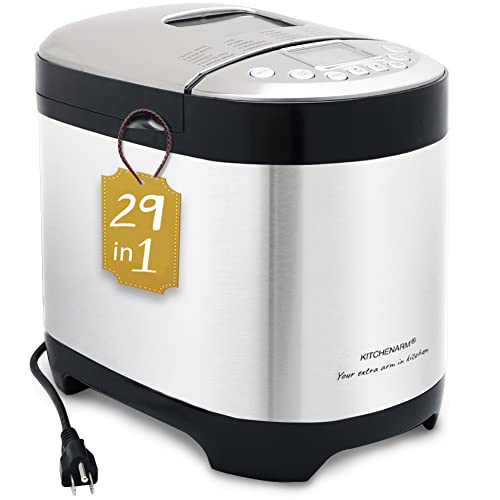
- 29 automatic programs plus a customizable HOME MADE cycle
- Three loaf sizes and three crust-color options
- Supports specialty breads and recipes including cake, jam, and yogurt
Best For: Bakers who want extensive controls and recipe flexibility
Best for Beginners
Elite Gourmet 2-Lb Programmable Bread Maker

- Automatic kneading, rising, and baking
- 19 one-touch programs, including gluten-free and dough settings
- Three loaf sizes plus delay timer and keep-warm functions
Best For: New users and small households wanting simple operation
Best for Large Loaves

- 2.2-pound capacity for larger households
- Dual heaters and automatic fruit-and-nut dispenser
- Ceramic pan, viewing window, and 15-hour delay timer
Best For: Families wanting large loaves and automatic add-ins
Best Value Features
Amazon Basics Programmable Bread Maker

- 14 settings for bread, dough, gluten-free recipes, and jam
- ExpressBake cycle makes bread in under 90 minutes
- 2-pound capacity with three crust-color choices
Best For: Budget-minded shoppers prioritizing simple automation and speed
Versatile Convection Pick
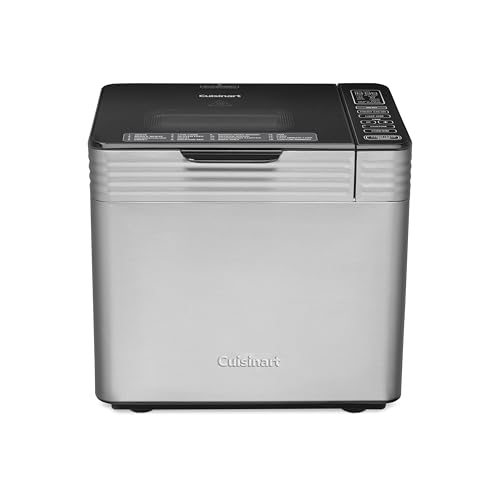
- 16 menu programs with convection baking
- Three loaf sizes and crust colors
- Automatic fruit-and-nut dispenser
Best For: Families wanting customizable 2-pound loaves
Best for Everyday Use
KITCHENARM 19-in-1 Bread Machine

- 19 menus plus a programmable Homemade cycle
- Supports 1-, 1.5-, and 2-pound loaves
- Includes recipes and a 15-hour delay timer
Best For: Beginners and experimental home bakers
Best Compact Choice

- Compact design with a carrying handle
- 19 programs for bread and non-bread recipes
- Makes 1- and 1.5-pound loaves
Best For: Small households with limited counter space
Best All-Around Features

- 17 programs plus custom baking control
- Ceramic pan and automatic nut dispenser
- Three loaf sizes with 53 included recipes
Best For: Versatile family baking and hands-off specialty loaves
Best for Large Traditional Loaves

- Makes horizontal loaves up to 3 pounds
- Dual knead blades for thorough mixing
- 12 programs and 13-hour delayed start
Best For: Families wanting larger, traditionally shaped loaves
Best for Custom Programs
KBS 20-in-1 Custom Bread Maker
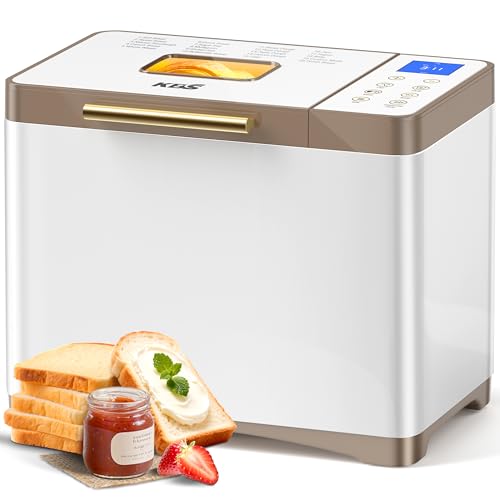
- 20 menus with detailed custom-stage control
- Ceramic pan and stainless steel paddle
- Three loaf sizes, hot-air circulation, and 15-hour timer
Best For: Experienced bakers fine-tuning specialty recipes
Most Customizable – KITCHENARM 29-in-1 Smart Bread Machine
For shoppers who want maximum control from their electric bread machines, the KITCHENARM offers 29 automatic programs plus a customizable HOME MADE cycle. It supports loaf sizes from 1 to 2 pounds, multiple crust colors, specialty breads, and non-bread recipes such as cake, jam, and yogurt.
Best For: Beginners and experienced bakers who want extensive recipe variety and personalized cycle settings.
Pros:
- 29 programs include gluten-free, whole wheat, rye, keto, brioche, sourdough, cake, jam, and yogurt options.
- HOME MADE mode lets you customize kneading, resting, rising, and baking cycles.
- Offers three loaf sizes, three crust colors, a 15-hour delay timer, and a one-hour keep-warm function.
- Includes a recipe book, recipe cloud access, nut and paddle alarms, and power-interruption recovery.
Cons:
- The extensive customization may be more than casual users need.
- The bread pan is listed for hand washing only.
- Its 14.2-inch depth may require careful counter-space planning.
Choose this model if flexibility is your priority. Its combination of preset menus and programmable cycles makes it one of the more adaptable electric bread machines in this roundup.
Best for Beginners – Elite Gourmet 2-Lb Programmable Bread Maker
The Elite Gourmet is a straightforward choice among electric bread machines, handling kneading, rising, and baking automatically. Its 19 one-touch programs cover everyday breads along with gluten-free recipes, dough, cake, jam, and other useful options.
Best For: First-time bread-machine users, small households, and shoppers seeking simple one-touch operation.
Pros:
- Automatic kneading, rising, and baking simplify the bread-making process.
- Accommodates 1-, 1.5-, and 2-pound loaves.
- Includes 19 presets covering white, wheat, rye, French, sweet, gluten-free, quick bread, dough, cake, and jam.
- A 15-hour delay timer and 60-minute keep-warm function help coordinate baking with your schedule.
Cons:
- It has fewer programs than the KITCHENARM model in this roundup.
- The supplied notes do not mention a viewing window or automatic ingredient dispenser.
- The pan is listed for hand washing only.
The Elite Gourmet focuses on accessible operation rather than advanced customization. It is a practical fit when you want fresh bread with minimal setup and a compact, energy-conscious design.
Best for Large Loaves – Neretva 2.2-Lb Bread Machine
The Neretva stands out among electric bread machines with a 2.2-pound maximum capacity, dual heaters, and an automatic fruit-and-nut dispenser. Its 15 programs include gluten-free, sugarless, yogurt, jam, and homemade settings, while the viewing window lets you monitor the bake.
Best For: Families or frequent bakers who want larger loaves, automatic add-ins, and potentially more even baking.
Pros:
- 2.2-pound capacity can serve up to six or seven people, according to the supplied notes.
- Dual top-and-bottom heaters are designed to support 360-degree surrounding baking.
- Automatic fruit-and-nut dispenser releases additions at the appropriate time.
- Includes a ceramic nonstick pan, viewing window, 15-hour timer, and one-hour keep-warm function.
Cons:
- At 15.8 pounds, it is heavier than the other listed machines.
- Its 15 programs provide less menu variety than the KITCHENARM.
- The larger capacity may be unnecessary for individuals or small households.
This is the strongest capacity-focused option in the group. Consider it when large loaves and hands-off add-ins matter more than having the widest selection of preset programs.
Best Value Features – Amazon Basics Programmable Bread Maker
The Amazon Basics bread maker offers the core functions many shoppers expect from electric bread machines at a compact size. It automatically mixes, kneads, rises, and bakes, while 14 settings include bread, dough, gluten-free, jam, and an ExpressBake cycle that makes bread in less than 90 minutes.
Best For: Budget-conscious shoppers who want basic bread-making automation and a fast-bake option.
Pros:
- ExpressBake setting produces bread in less than 90 minutes, according to the supplied notes.
- Automatically mixes, kneads, rises, and bakes.
- Offers 14 settings for breads, doughs, gluten-free recipes, jams, and more.
- Includes a 2-pound capacity, three crust colors, LCD display, and 550-watt motor.
Cons:
- It has fewer programs than the Elite Gourmet, Neretva, and KITCHENARM models listed here.
- The supplied notes do not mention a delay timer or keep-warm function.
- It offers less capacity than the Neretva’s 2.2-pound loaf size.
This model keeps the feature set focused and adds a useful ExpressBake option. It is a sensible pick for shoppers who want automated bread, dough, and gluten-free preparation without advanced programming.
Versatile Convection Pick – Cuisinart 2-Lb Bread Maker
For shoppers comparing electric bread machines, the Cuisinart CBK-200 is a versatile option with 16 menu programs, three loaf sizes, and convection baking. It can make loaves up to 2 pounds while letting you select a light, medium, or dark crust.
Best For: Families and bakers who want larger loaves, varied programs, and an automatic fruit-and-nut dispenser.
Pros:
- Offers 16 menu programs for different breads and baked goods.
- Supports three loaf sizes up to 2 pounds and three crust colors.
- Convection fan helps circulate air for consistent crust color and texture.
- Automatic dispenser adds fruit and nuts during the cycle.
Cons:
- Its 2-pound capacity and 10.8-pound weight may be more than smaller households need.
- The stainless-steel unit has a relatively tall 13-inch profile.
The Cuisinart stands out when flexibility matters most. Its convection fan and ingredient dispenser add useful automation, while the 2-pound capacity makes it a practical choice for households that regularly bake larger loaves.
Best for Everyday Use – KITCHENARM 19-in-1 Bread Machine
The KITCHENARM is one of the more flexible electric bread machines for beginners and experienced home bakers alike. Its 19 menus include bread, cake, jam, yogurt, dough, gluten-free options, and a programmable Homemade cycle.
Best For: Beginners and health-conscious bakers who want recipe guidance, gluten-free settings, and detailed cycle control.
Pros:
- Includes 19 preset menus plus a fully programmable Homemade menu.
- Offers 1-, 1.5-, and 2-pound loaf sizes with three crust colors.
- Includes 57 recipes and access to additional recipes through the KitchenArm Recipe Cloud.
- Features a 15-hour delay timer, ingredient alarms, and saved settings for repeat recipes.
Cons:
- The extensive settings may feel less simple than a basic bread maker.
- The polypropylene exterior may appeal less to shoppers seeking an all-metal design.
This model is a strong fit for users who want to experiment rather than rely only on preset recipes. Its programmable cycle, gluten-free support, and recipe resources provide room to adapt recipes over time.
Best Compact Choice – Briskind 1.5-Lb Bread Maker
The Briskind is a compact entry in the electric bread machines category, designed for one- or two-person households and families of about two or three. It makes 1- or 1.5-pound loaves and includes 19 programs, a carrying handle, and a 15-hour delay timer.
Best For: Small households that want varied menus and fresh bread without using the counter space of a larger machine.
Pros:
- Compact 1.5-pound capacity is suited to two or three people.
- Includes 19 programs, including gluten-free, low-carb, yogurt, jam, and dough settings.
- Provides knead-only, rise-only, and bake-only controls for recipe customization.
- Includes keep-warm, power-failure backup, fruit-and-nut alerts, and a carrying handle.
Cons:
- Its 1.5-pound maximum loaf is smaller than the 2-pound capacity of some alternatives.
- It is designed for 120-volt use and is not suitable for 230-volt areas such as the UK and EU.
The Briskind prioritizes a smaller footprint without giving up specialty programs. Its compact capacity, manual cycle controls, and included accessories make it a practical choice when counter space and portion size are important.
Best All-Around Features – KBS Pro 17-in-1 Bread Maker
For shoppers comparing electric bread machines, the KBS Pro stands out with broad program coverage, a ceramic pan, automatic mix-in dispenser, and three loaf sizes. Its combination of guided recipes and customizable settings makes it approachable for beginners while leaving room for experimentation.
Best For: Families and home bakers who want versatile programs, automatic add-ins, and multiple loaf sizes.
Pros:
- 17 automatic programs plus a custom setting, including gluten-free, sourdough, dough, yogurt, and jam.
- Supports 1-, 1.5-, and 2.2-pound loaves with light, medium, and dark crust choices.
- Ceramic pan and paddle, automatic stainless steel nut dispenser, convection heating, and a 15-hour delay timer.
- Includes 53 recipes and useful accessories such as measuring tools, a glove, and paddle-removal hook.
Cons:
- The feature-rich touch-panel design may be more than casual users need.
- The largest 2.2-pound capacity may be excessive for households that bake small loaves.
Choose this model if you want one machine to cover everyday bread, specialty doughs, and mix-in recipes. Its strong program selection and hands-off dispenser give it especially broad appeal.
Best for Large Traditional Loaves – West Bend Hi-Rise Bread Maker
Among electric bread machines, the West Bend Hi-Rise is a practical choice for shoppers who prefer traditionally shaped horizontal loaves. Its 3-pound capacity, dual knead blades, straightforward programs, and delayed start support everyday family baking.
Best For: Households that want larger horizontal loaves and simple controls for bread and dough.
Pros:
- Horizontal pan accommodates 2-, 2.5-, and 3-pound loaf sizes.
- Dual knead blades are designed to thoroughly mix dough and promote a higher rise.
- Offers 12 settings, including basic, wheat, French, sweet, dough, and gluten-free options.
- Includes three crust colors, a 13-hour delayed start, and recipes for bread, bagels, pasta dough, and more.
Cons:
- Its 432-watt motor is lower-powered than the two KBS models in this roundup.
- Hand-wash care is specified for the included components.
- It has fewer programs and a shorter delay timer than some feature-heavy alternatives.
The Hi-Rise makes sense when loaf shape and capacity matter more than an extensive menu of specialty functions. Its dual-blade design and included recipes keep the experience focused and practical.
Best for Custom Programs – KBS 20-in-1 Custom Bread Maker
For experienced bakers comparing electric bread machines, this KBS model offers unusually detailed process control. Its 20 menus include a smart custom program that lets you adjust individual stages, while the ceramic pan, stainless steel paddle, and temperature-management features support repeatable results.
Best For: Bakers who want to fine-tune rise, kneading, and baking stages for specialized recipes.
Pros:
- 20 menus and a custom program with control over each step of the bread-making process.
- Ceramic nonstick pan and stainless steel paddle designed for easier release and durability.
- 360-degree hot-air circulation, variable-speed mixing, and temperature monitoring are designed for even results.
- Offers 1-, 1.5-, and 2.2-pound loaves, three crust colors, a 15-hour timer, and 60-minute keep-warm function.
Cons:
- The extensive customization may require more learning than a basic bread machine.
- The supplied notes do not specify the full recipe-book contents.
This is the strongest fit for users who see a bread machine as a programmable baking tool rather than a one-button appliance. If you mainly want basic loaves, its advanced controls may be unnecessary.
How We Picked the Best Electric Bread Machines
We focused on the features that matter most in everyday baking: loaf capacity, bread and dough programs, crust settings, gluten-free options, programmable controls, cleanup, and overall versatility. We also considered practical differences such as compact footprints, carrying handles, ceramic or nonstick pans, automatic nut dispensers, and custom cycle controls.
Because bread machines serve different types of bakers, the list includes simple beginner-friendly models as well as machines designed for recipe experimentation. A larger program count can be useful, but it does not automatically make a machine better; clear controls, reliable basic cycles, and a pan size that matches your household are often more important.
Quick Comparison
| Best For | Features to Look For |
|---|---|
| Beginners | Simple presets, readable controls, and dependable basic bread cycles |
| Families | 2- to 2.2-pound capacity and multiple loaf-size settings |
| Gluten-free baking | A dedicated gluten-free program and a customizable cycle |
| Recipe experimentation | Homemade or custom programming with adjustable stages |
| Small kitchens | Compact dimensions, lighter weight, and a carrying handle |
| Mix-ins | An automatic nut or ingredient dispenser |
Key Buying Factors for Electric Bread Machines
Capacity and Loaf Size
Most machines in this roundup make loaves from about 1 to 2.2 pounds. Smaller loaves suit individuals and couples, while a 2-pound or larger machine is more practical for families. Check whether the listed capacity refers to finished loaf weight and whether the machine supports multiple sizes.
Programs and Customization
Common presets include white, whole wheat, sweet, rapid, dough, jam, and cake. A gluten-free setting can simplify specialized recipes, while a homemade or custom cycle is valuable if you want to adjust kneading, rising, or baking times. More presets are helpful only when the controls remain easy to understand.
Pan, Paddle, and Cleanup
Nonstick pans are generally easy to clean, while ceramic-coated pans may appeal to shoppers who prefer an alternative cooking surface. Removable pans and paddles make cleanup easier. Always use the manufacturer’s recommended utensils to avoid damaging the coating.
Dispensers, Timing, and Controls
An automatic dispenser can add nuts, seeds, fruit, or other ingredients at the correct stage. A delay timer helps coordinate fresh bread with breakfast or dinner, but perishable ingredients should be handled according to the manufacturer’s instructions. Look for a display and buttons you can operate without consulting the manual every time.
Who Should Buy Which Electric Bread Machines?
Choose a compact 1.5-pound machine if counter space and storage are your main concerns. Beginners should prioritize straightforward presets and a reliable basic cycle over an overwhelming menu. Families and frequent bakers will usually benefit from a 2- to 2.2-pound model with several loaf sizes and crust colors.
If you bake gluten-free bread, select a machine with a dedicated gluten-free program and verify that the recipe instructions match the appliance. For bakers who like to modify recipes, prioritize custom programming or a homemade cycle. Finally, choose an automatic dispenser model if you regularly add nuts, seeds, or dried fruit and want more consistent results with less monitoring.